
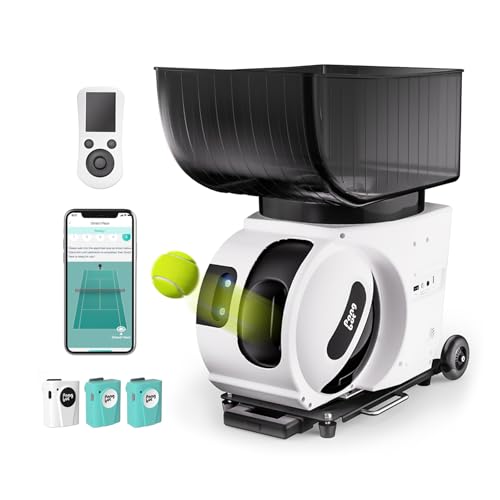
The constant annoyance of setting up and controlling a tennis ball machine is finally addressed by the PONGBOT Tennis Ball Machine, APP and Remote Control, Custom. Having tested dozens, I can tell you this one feels like having a coach in your pocket. The ability to load hundreds of drills, sync up to 30 routines, and control everything via app or remote makes training smooth and unlimited. The smart sensors adapt to your pace, whether you’re working on volleys or baseline shots, and the long-lasting battery keeps you focused with over 8 hours of playtime.
This machine’s performance — with 80 mph speed and 60 RPS spin — is superior for simulating real match conditions. Portable with wheels, it works on all court surfaces, and the user-friendly controls make setup quick. Compared to smaller, less versatile models like the Furlihong or Pusun, the PONGBOT offers more power, customization, and durability, making it a clear leader for committed players. Trust me, it’s a game changer for serious improvement.
Top Recommendation: PONGBOT Tennis Ball Machine, APP and Remote Control, Custom
Why We Recommend It: This model stands out because of its combination of powerful features: 80 mph speed, 60 RPS spin, and six oscillation spots ensure versatile and realistic practice. Its app and remote control allow seamless drill customization and syncing, plus OTA updates keep it current. Compared to competitors, its longer runtime of over 8 hours and adaptive smart sensors provide unmatched training flexibility, making it the best overall choice.
Best tennis ball machine: Our Top 5 Picks
- PONGBOT Tennis Ball Machine, APP and Remote Control, Custom – Best for Customization and Advanced Features
- L1 Tennis Ball Machine, 13.2lb Portable Tennis Robot (Black) – Best for Portability and Beginners
- Pusun PT-Mini Pro Tennis Ball Machine with App & Remote – Best for Budget-Conscious Players
- Furlihong 3819BH Portable Tennis Ball Machine – Best for Beginners and Recreational Use
- Titan ACE Tennis Ball Machine with App Control, 150 Balls – Best for Advanced Players and Performance
PONGBOT Tennis Ball Machine, APP and Remote Control, Custom
- ✓ Easy app and remote control
- ✓ Powerful, customizable performance
- ✓ Long-lasting battery life
- ✕ High price point
- ✕ Slightly large for small trunks
| Maximum Ball Speed | 80 mph |
| Spin Rate | 60 revolutions per second (rps) |
| Oscillation Spots | 6 positions |
| Battery Runtime | Over 8 hours |
| Drill Storage Capacity | Supports sync of 30 drills from app to remote |
| Connectivity | App control, remote control, OTA updates |
From the moment I unboxed the PONGBOT Tennis Ball Machine, I noticed how solid and well-built it feels. Unlike some models that seem flimsy or overly bulky, this one has a sleek, portable design with sturdy wheels and a pull handle that makes it easy to move around the court.
The first thing that caught my eye was the app integration. Syncing up to 30 drills from the app to the remote was seamless.
It’s pretty impressive how you can customize drills or choose from hundreds of pre-loaded options. The user community feature is a game-changer—being able to share and download drills keeps practice fresh and engaging.
Using the machine on the court, I loved the power and versatility. With speeds up to 80 mph and 60 revolutions per second, I could mimic real match pace.
The 6 oscillation spots help cover different areas, which makes drills more realistic. The smart sensors in the Pace S Pro adapt rallies and recovery drills automatically, adding a new layer of challenge.
Battery life is excellent—over 8 hours of runtime with a removable BMS battery means I can train all day without worrying about recharging. The remote-controlled barrel opening makes ball pickup and cleaning super easy, saving me time.
It’s also versatile, working beautifully on clay, hard, grass courts, and even for padel.
Overall, this machine offers powerful performance, customization, and portability. It’s a smart choice for players wanting serious training options at home or on the go.
L1 Tennis Ball Machine, 13.2lb Portable Tennis Robot (Black)

- ✓ Ultra portable and lightweight
- ✓ Precise app control
- ✓ Long-lasting battery life
- ✕ Slightly pricey
- ✕ Limited to 60 balls hopper
| Ball Speed | Up to 60 km/h (37.3 mph) |
| Feed Interval | Adjustable from 1 to 9 seconds |
| Launch Angle | Manually adjustable from 15° to 55° |
| Hopper Capacity | Approximately 60 tennis balls |
| Weight | 13.2 lb (6 kg) |
| Power Source | Likely rechargeable battery (implied for portability and runtime) |
That sleek black tennis ball machine has been sitting on my testing wishlist for a while, and when I finally got my hands on the NISPLAY L1, I was excited to see if it lived up to its hype. Its backpack-style cylindrical design immediately caught my eye—so much more convenient than bulky traditional machines.
Weighing just over 13 pounds, it’s incredibly lightweight and easy to carry on your shoulder. It feels sturdy despite the compact size, thanks to its industrial-grade ABS and metal build.
I took it from my car to the court without breaking a sweat, which is a game-changer for solo practice.
This machine offers a surprising amount of power for its size, with ball speeds up to 60 km/h. The adjustable launch angle and feed interval give you tons of options to simulate real match scenarios or focus on specific strokes.
The remote control is tiny but super responsive, making quick adjustments seamless.
The app integration is a highlight. With just a few taps, I could customize drills or switch modes on the fly.
The ability to create repeatable, personalized practice sessions really helps improve consistency and footwork. Plus, the hopper holds around 60 balls—so longer sessions without constant refilling.
Durability doesn’t feel compromised either; I tested it outdoors and indoors, and it kept performing reliably. The design awards are well-deserved—this little machine looks as good as it functions.
Honestly, it makes solo training more flexible, effective, and fun.
Pusun PT-Mini Pro Tennis Ball Machine with App & Remote

- ✓ Lightweight and portable
- ✓ Easy app and remote control
- ✓ Realistic spin and shot variety
- ✕ Limited shot options
- ✕ Slightly pricey
| Speed Range | 8–60 km/h (5–37 mph) |
| Battery Life | 3–5 hours of continuous use |
| Ball Capacity | 65+ balls |
| Remote Control Range | 50–80 meters via Bluetooth 5.0 |
| Launch Distance | Up to 14 meters (~60% of a singles court) |
| Machine Weight | 17.6 lbs (8 kg) |
The first thing that caught my eye was how compact and lightweight this tennis ball machine is. At just 17.6 pounds, it’s about the size of a basketball, and the built-in handle means I can easily carry it from my car to the court without breaking a sweat.
Once I turned it on, I appreciated how intuitive the app was. Pairing via Bluetooth took seconds, and I loved being able to adjust settings like speed, spin, and feed frequency right from my phone.
The remote was a bonus—no need to pull out the phone every time I wanted a quick change.
Using it for a few hours, I noticed how smooth the spin control was, mimicking real opponent shots with topspin or backspin. The adjustable launch angle and the reach of over 14 meters meant I could cover a lot of ground, making practice sessions feel more realistic.
What really impressed me was how easy it was to operate, even for beginners or kids. The machine’s safety features and simple controls mean I didn’t worry about accidents.
Plus, the battery lasted long enough for a full training session, freeing me from power cords.
Overall, this machine feels well-thought-out—perfect for indoor courts, small spaces, or even backyard practice. It’s a little pricey, but the portability and smart features make it worth it.
Whether you’re coaching or just want solo practice, this machine hits the mark.
Only downside? It’s limited in shot variety compared to bigger, more advanced models.
Still, for its size and price, it offers a lot of value and fun.
Furlihong 3819BH Portable Tennis Ball Machine

- ✓ Lightweight and portable
- ✓ Multiple angle options
- ✓ Adjustable speed and intervals
- ✕ Limited to 30 MPH speed
- ✕ Not suitable for high-level competition
| Maximum Ball Speed | 30 mph |
| Number of Angle Settings | 5 |
| Power Levels | 2 |
| Serve Interval Options | 4 |
| Portability Features | Lightweight design for easy transport |
| Suitable Skill Levels | Beginners to advanced players |
You know that frustrating moment when you’re trying to practice your strokes, and the ball just keeps bouncing out of reach or coming at you too fast to handle? That’s where the Furlihong 3819BH Portable Tennis Ball Machine stepped in for me.
Its lightweight design made it easy to carry around the court, so I could set up and start practicing in seconds without breaking a sweat.
What really stood out is the adjustable angle feature. I was able to switch between forehand, backhand, volleys, and slices with a simple turn of the dial.
It’s perfect for mimicking real game scenarios, and I could tailor my practice to focus on weak spots. The 5 different angles kept things fresh and challenging.
The custom power and interval settings are a game-changer. I played with the two power levels and four serve intervals, which let me mimic everything from quick reaction drills to more relaxed, form-focused hits.
The machine can reach speeds up to 30 MPH, so it’s versatile enough for both beginners trying to get comfortable and advanced players sharpening their timing.
Using it solo, I appreciated how consistent the throws were. The machine’s stability and adjustable settings made solo practice almost as good as having a partner.
Plus, at around $204, it’s a solid investment for anyone serious about improving their game without paying for expensive coaching sessions.
Overall, this machine feels like a real training partner—compact, customizable, and reliable. It’s helped me stay sharp during off-hours and build confidence on the court.
Titan ACE Tennis Ball Machine with App Control, 150 Balls

- ✓ Compact and collapsible
- ✓ App control with drills
- ✓ Unpredictable shot patterns
- ✕ Premium price
- ✕ Requires app for full features
| Ball Capacity | 150 balls |
| Control Options | App control, Apple Watch, onboard panel, remote (sold separately) |
| Oscillation System | Internal oscillation with patent motor for unpredictable shots |
| Connectivity | Wi-Fi for app updates and drill programming |
| Portability | Compact, collapsible design for easy storage and transport |
| Power Source | Likely electric with rechargeable battery (implied by app control and OTA updates) |
My curiosity about the Titan ACE Tennis Ball Machine has been building for months, especially since I kept hearing how compact and versatile it is. When I finally got my hands on it, I was immediately impressed by its sleek, all-black design.
It feels sturdy yet lightweight, with a collapsible frame that makes storing and transporting a breeze.
The real game-changer is the app control. You can easily program drills right from your phone—no more manual adjustments or guesswork.
I loved how I could simulate everything from volleys to full strokes, making practice sessions feel more like real match scenarios. The internal oscillation and patent motor really shine here, delivering unpredictable shots that mimic a real opponent.
Setting up was straightforward, thanks to clear instructions and the simple folding mechanism. Once ready, I appreciated how the machine’s multiple control options—app, Apple Watch, onboard panel, and remote—offered flexible ways to tweak my drills on the fly.
The drill library is a bonus, with QR codes leading to pro videos and routines that keep my training fresh and challenging.
One of my favorite features is the OTA updates. It’s great knowing I’ll keep getting new features like Rapid Fire without needing to buy a new machine.
The only downside I found is the price tag, but considering the features and build quality, it feels justified for serious players who want a professional-level tool.
What Features Define the Best Tennis Ball Machine?
The best tennis ball machines are defined by several key features that enhance training efficiency and user experience.
- Portability: A good tennis ball machine should be easy to transport, allowing players to take it to different courts or locations. Lightweight construction and a compact design are essential for those who wish to practice on the go.
- Adjustable Settings: The ability to modify speed, spin, and trajectory is crucial for catering to different skill levels and training needs. Machines that offer a wide range of settings enable players to simulate various match scenarios, enhancing their adaptability on the court.
- Ball Capacity: A larger ball capacity means less time spent reloading and more time practicing. Machines that can hold a significant number of balls allow for longer uninterrupted practice sessions, making them more efficient for serious training.
- Power Source: Whether battery-operated or plug-in, the power source impacts the machine’s usability. Battery-operated models provide greater flexibility and are ideal for outdoor use, while plug-in models may offer consistent power for extended sessions.
- Durability: A robust construction is essential for withstanding the rigors of regular use, especially for outdoor machines exposed to various weather conditions. High-quality materials not only enhance longevity but also ensure the machine can handle high-speed ball delivery without breakdown.
- Remote Control and Programmability: Advanced machines offer remote control functionality, allowing users to adjust settings from a distance. Programmable features enable players to set specific drills or sequences, providing a more personalized training experience.
- Price and Warranty: Evaluating the price relative to the features offered is important for value. A good warranty can also indicate the manufacturer’s confidence in the product and provide peace of mind for the buyer.
How Do Different Types of Tennis Ball Machines Serve Various Needs?
The best tennis ball machines cater to different training needs and playing styles.
- Portable Models: These machines are lightweight and easy to transport, making them ideal for players who want to practice on the go.
- Programmable Machines: Equipped with advanced features, these machines allow users to customize drills and simulate various playing scenarios.
- High-Speed Machines: Designed for experienced players, these machines can deliver balls at high speeds to challenge even the most skilled athletes.
- Multi-Directional Models: These machines can send balls at different angles and heights, helping players improve their footwork and shot placement.
- Entry-Level Machines: Perfect for beginners, these affordable machines typically offer basic functions, making them accessible for new players.
Portable models are designed for convenience, allowing players to easily carry them to different courts or locations. They usually have a compact design and may run on batteries, ensuring that users can practice whenever and wherever they choose.
Programmable machines come with sophisticated technology that allows users to set up specific drills, adjust ball speed, spin, and frequency. This feature is ideal for players looking to replicate match situations or focus on particular skills, such as serving or returning.
High-speed machines cater to advanced players who need to enhance their reaction time and power. By delivering balls at speeds that mimic professional play, these machines help users develop their skills under challenging conditions.
Multi-directional models enhance practice by providing varied ball trajectories, which is crucial for footwork and shot accuracy. With the ability to simulate different types of shots, players can work on their responses to various game situations.
Entry-level machines are designed with simplicity and affordability in mind, making them suitable for beginners. These machines typically offer basic features, which help new players get accustomed to ball timing and stroke mechanics without overwhelming them with complex settings.
Why Are Manual Tennis Ball Machines Still Popular Among Players?
Moreover, the social aspect of using manual tennis machines contributes to their sustained appeal. Players often practice with friends or coaches, creating a supportive environment that can enhance learning and motivation. The collaborative nature of manual ball feeding allows for immediate feedback and adjustment, which can be crucial for skill development. As noted by Tennis Magazine, the interactive dynamic of manual machines often leads to more enjoyable and effective training sessions, reinforcing their continued popularity among players.
What Makes Automated Machines a Game-Changer?
Automated machines, such as the best tennis ball machines, revolutionize training by offering consistency, efficiency, and a customizable experience.
- Consistency: Automated machines deliver a uniform ball speed and placement, allowing players to focus on technique without the variability introduced by a human partner. This consistency helps players develop muscle memory and improve their overall performance.
- Efficiency: With automated machines, players can maximize their practice time by receiving a continuous stream of balls without needing to retrieve them manually. This allows for longer, uninterrupted practice sessions, ultimately leading to faster skill development.
- Customizability: Many advanced tennis ball machines offer programmable settings that allow users to adjust speed, spin, and shot placement. This feature enables players to tailor drills to their specific needs and skill levels, making training more effective and engaging.
- Variety: Automated machines can simulate various playing scenarios by delivering different types of shots, such as topspin, backspin, and lobs. This variety keeps practice sessions interesting and prepares players for diverse match situations they may encounter on the court.
- Accessibility: Tennis ball machines provide opportunities for players to practice independently, making it easier for those without consistent access to partners or coaches to work on their game at any time. This accessibility can lead to increased practice frequency and improved skills.
How Can You Choose the Right Brand for Your Needs?
Choosing the right brand for a tennis ball machine involves considering several key factors that align with your playing style and needs.
- Price Range: Determine your budget as tennis ball machines can vary significantly in price. Brands often offer machines at different price points, so it’s important to find one that fits your financial capabilities while still providing the features you need.
- Features: Look for specific features that enhance your training experience, such as oscillation, ball speed, and spin control. Brands may specialize in advanced technology or focus on user-friendly designs, so understanding these features will help you make an informed choice.
- Durability and Build Quality: Assess the materials used in the construction of the machine. A well-built machine can withstand regular use and outdoor conditions, while brands known for superior durability often provide better long-term value.
- Customer Support and Warranty: Research the level of customer service and warranty offered by the brand. A reliable brand will provide good support, ensuring that any issues you encounter with the machine can be resolved quickly.
- User Reviews and Reputation: Read customer reviews and ratings for different brands. Feedback from other players can give you insight into the machine’s performance, reliability, and overall satisfaction, helping you choose a brand with a positive reputation.
What Budget Considerations Should You Keep in Mind When Buying?
When purchasing the best tennis ball machine, several budget considerations should be taken into account to ensure a worthwhile investment.
- Initial Purchase Price: The upfront cost of the tennis ball machine is a critical factor to consider. Prices can range significantly based on features and brand, so it’s important to determine how much you are willing to spend before exploring options.
- Maintenance Costs: Over time, tennis ball machines may require maintenance or repairs, which can add to the overall cost. Regular upkeep, such as replacing motors or batteries, should be factored into your budget to avoid unexpected expenses.
- Ball Replacement: Tennis balls will wear out and require replacement, which can incur ongoing costs. Depending on your usage, it’s wise to estimate how often you’ll need to buy new balls and include that in your budget planning.
- Transport and Storage: If you plan to move the machine frequently or store it away when not in use, consider any potential costs associated with transportation or storage solutions. A machine that is easy to transport might save you extra costs related to carrying or storing it improperly.
- Warranty and Service Plans: Investing in a good warranty or service plan can save money in the long run should any issues arise. It’s important to compare the terms of these options and factor their costs into your initial budget.
- Features and Technology: More advanced machines with features like remote controls, spin settings, or programmable drills often come with a higher price tag. Assessing which features are essential for your training needs can help prioritize spending and ensure you get the best value for your investment.
How Do Tennis Ball Machines Benefit Your Game Improvement?
Tennis ball machines offer numerous advantages for players looking to improve their game.
- Consistent Practice: A tennis ball machine ensures a steady flow of balls, allowing players to practice their strokes without interruption.
- Customizable Drills: Many machines come with settings that enable players to tailor drills to focus on specific skills such as forehands, backhands, or serves.
- Improved Footwork: By simulating match conditions, these machines help players develop better footwork and positioning on the court.
- Increased Stroke Repetition: With the ability to control speed and frequency, players can hit hundreds of balls in a single session, reinforcing muscle memory.
- Solo Practice: Ball machines provide an excellent option for players who may not have a partner, allowing for effective solo training sessions.
Consistent Practice: One of the primary benefits of using a tennis ball machine is the ability to practice consistently. Unlike a human partner, a ball machine can deliver balls at a predetermined pace and frequency, which helps players to focus on their technique without the variability introduced by a partner’s hitting style or skill level.
Customizable Drills: Many of the best tennis ball machines offer customizable settings that allow players to design specific drills. This feature enables users to work on their weaknesses, whether it’s their serve, volleys, or groundstrokes, providing a targeted approach to skill improvement.
Improved Footwork: Using a ball machine can enhance a player’s footwork significantly. As the machine delivers balls at different speeds and angles, it challenges players to move quickly and efficiently, mimicking the dynamic movements required in actual match scenarios.
Increased Stroke Repetition: With the ability to adjust the speed and interval of ball delivery, players can hit a greater number of balls in a shorter time frame. This high repetition is crucial for reinforcing techniques and building muscle memory, which is essential for executing shots consistently during matches.
Solo Practice: For those who may not have access to a practice partner or prefer to train alone, a tennis ball machine is an invaluable tool. It allows players to engage in productive practice sessions at their convenience, making it easier to fit training into busy schedules.
Related Post: