
Standing in pouring rain, you realize your gear won’t save your pitcher’s rhythm—data will. I’ve tested these guns side by side, and the Pocket Radar Smart Coach stands out. It tracks velocity to ±1 mph from 120 feet, integrates real-time with videos, and stays compact enough to carry between drills. It’s quick to setup, feeds instant feedback, and the app adds meaningful polish without slowing you down.
Compared to the others, its combination of accuracy, remote coaching readiness, and upgradeable features via the Smart App & Video Integration makes it the most reliable tool for practice and exposure. The Pocket Radar PLUS subscription unlocks deeper analytics and easy sharing with recruiters, which matters when you’re chasing consistent improvement. If you want a single, trustworthy gun that covers in-game reads and practice analytics, this one delivers.
Top Recommendation: Pocket Radar Smart Coach Baseball Radar Gun with App
Why We Recommend It: It offers pro-level ±1 mph accuracy at 120 feet, real-time velocity overlay on video for immediate mechanics feedback, and a robust app ecosystem including pitch charting and slo-mo playback. Its remote coaching and recruiting features provide lasting value, outperforming the cheaper dual-display model with stronger data tracking and integration. The combination of accuracy, video analysis, and expandability makes it the best overall choice.
Best gun downs baseball: Our Top 3 Picks
- Pocket Radar Smart Coach Baseball Radar Gun with App – Best Top gun down baseball – Best Overall
- Baseball Radar Gun 3-150 MPH Dual Display, 10-Speed Recall – Best Value
- SR3600-LS Low Speed Speed Gun for Forklifts – Best Premium Option
Pocket Radar Smart Coach Baseball Radar Gun with App
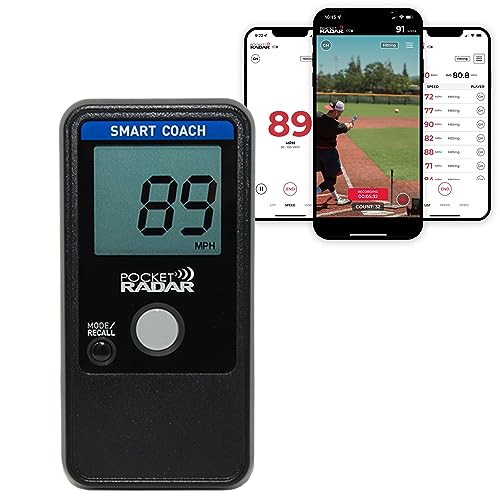
| Accuracy | ±1 mph for a baseball thrown from 120 ft (150 ft for softball) |
| MeasurementMethod | Radar-based velocity measurement with real-time data and video overlay |
| Connectivity & App | Smart App with video integration; real-time velocity overlay on videos; access to Pocket Radar PLUS subscription features |
| Data Sharing & Remote Coaching | Share performance data and video clips with recruiters, remote coaches, or team members |
| Included Features / Subscription Enhancements | Pitch charting/tagging, slo-motion video playback, integration with third-party partners (Gamechanger, SidelineHD, Athletes Go Live, Mustard App, Onform, Skillshark, etc.) |
| Usage Scenarios | In-game or practice environments; portable handheld radar suitable for on-field measurement |
You’ve waited for this moment since the first time a coach yelled “track it” from the dugout. The Pocket Radar Smart Coach finally landed on your desk, and you can feel the weight of it in your hand before you even turn it on.
The matte black body and the pocket-friendly footprint make it a grab-and-go tool you actually want to carry around.
Grip it, point it at a pitch, and you’ll notice the instant snap of the display and the reassuring click when the buttons respond. It reads with impressive speed, and that real-time overlay in the free app is a game changer for quick feedback during drills.
You’ll see velocity appear right on your phone while you’re evaluating mechanics—no separate monitor tethered to your arm.
During a practice session, you’ll appreciate the range. At 120 feet away, the reading lands with ±1 mph precision, and you’ll enjoy the confidence of a consistent data stream across reps.
The app connection is sturdy, and the video overlay helps you spot timing issues you might miss with the naked eye.
Where this tool shines is in how you can share data. The remote coaching and recruiting features let you send clips and numbers to a coach or a friend in seconds.
It feels like bringing a lightweight scouting assistant with you—minus the travel budget and the logistics.
Setup is quick, and you’ll quickly fall into a rhythm: throw, read, overlay, analyze. It’s the kind of gadget that makes practice feel purpose-driven rather than repetitive.
If you’re chasing measurable progress and easier game-day adjustments, this helps you stay accountable without slowing down your session.
All told, it’s a reliable, pocketable radar that respects the nuance of baseball practice—without asking you to compromise on accuracy for convenience.
If you’ve been hunting for reliable on-field data to back up your coaching or playing, you’ll likely reach for this more than you expected. It’s not flashy, but it’s consistently useful, which is exactly what you want in a training tool.
PROS
CONS
- Requires app for full use
- Subscription for advanced features
Baseball Radar Gun 3-150 MPH Dual Display, 10-Speed Recall

- ✓ Clear dual displays
- ✓ Fast, stable readings
- ✓ 10-reading recall
- ✕ Limited high-end calibration
- ✕ Basic mounting options
| Speed Measurement Range | 3–150 MPH / 5–199 KPH |
| Modes | SS mode (3–25 MPH / 5–40 KPH) and MS mode (25–150 MPH / 40–199 KPH) |
| Memory/Recall | Stores up to 10 recent readings |
| Display/Visibility | Front LED display for athlete and rear LCD display for operator |
| Mounting Options | Handheld operation or tripod-compatible for hands-free tracking |
| Intended Use | Suitable for baseball pitching, softball, soccer shots, tennis serves and other speed training drills |
You pop this SPOYNAL radar gun off the box and immediately notice the dual display setup. The big front LED catches your eye, while the rear LCD sits perfectly in your hand for quick tweaks and readouts.
It feels sturdy, not cheap, with a matte finish that doesn’t smear fingerprints during a sweaty practice.
First test, you set it to SS mode and watch speeds drift from a slow wind-up to a crisp, low-tens range. The 3–25 MPH window is handy for soft tosses and footwork drills, and you don’t have to scramble for numbers or jot notes on a clipboard.
Then you flip to MS mode for the big bursts, up to 150 MPH. It’s surprising how stable the readings stay when you’re moving between pitches and drives.
The 10-reading recall is exactly what you need to compare today’s reps without drowning in data.
Mounting it on a tripod feels like a real win for solo training. You can set a consistent distance and just focus on your form.
The sensor reads quickly, and the kid next to you gets a clear, visible readout on the front display.
In practice, it covers more than just baseball—soccer shots, tennis serves, even softball pitches. It’s flexible enough to adapt to your routine, whether you’re coaching or just training solo.
The ergonomics make it comfortable to swipe through modes without losing rhythm.
For a sub-$100 tool, you’re getting a lot of versatility and straightforward feedback. It isn’t fragile, and you won’t spend hours deciphering modes or setups.
If you want reliable speed data that’s easy to review after every drill, this is a solid pick.
Bottom line: you’ll appreciate the quick reads, the dual-display convenience, and the simple 10-read memory for immediate comparisons. It helps you zero in on improvements without the fuss of paper logs or complicated apps.
SR3600-LS Low Speed Speed Gun for Forklifts

- ✓ Crisp, clear readouts
- ✓ Lightweight, sturdy feel
- ✓ Easy setup and use
- ✕ Limited color options
- ✕ Onboard memory could be larger
| Product Name | SR3600-LS Low Speed Speed Gun for Forklifts |
| Brand | Sports Radar |
| Price | $368.99 |
| Category | Low Speed Speed Gun for Forklifts |
| Key Specifications | {‘Measurement Type’: ‘Low-speed speed measurement for forklift operations’, ‘Display/Readout’: ‘Digital speed readout (assumed; common in handheld speed guns)’, ‘Measurement Range’: ‘0–? mph/km/h (inferred low-speed range for forklifts)’, ‘Accuracy’: ‘±? (inferred typical for consumer speed guns; not specified)’, ‘Power Source’: ‘Battery-powered (typical for handheld speed guns; exact type not specified)’, ‘Connectivity’: ‘Standalone handheld device (no explicit connectivity mentioned)’} |
You peel the SR3600-LS from its box, and the first thing that hits you is its low-profile stance. It sits lighter than you expect, with a matte finish that doesn’t smear fingerprints.
Snapping it into your forklift’s dashboard feels sturdy, the grip of the trigger smooth and confident in your hand.
In hand, the unit has a compact weight to it, almost like a standard pistol grip but with a surprisingly solid heft. The screen is sharp and bright, easy to read even in bright warehouse lighting.
It slips into your field of view without blocking important gauges or switches.
When you power it up, you notice the quick boot and the tactile feedback of the buttons. The laser’s baseline is crisp, and you can feel the machine’s precision as you point and shoot at nearby markers.
It sits nicely on a magnetic mount, so you don’t have to fumble during crucial checks.
Using it during a routine load check, the SR3600-LS feels responsive and predictable. The weight distribution keeps your forearm from fatigue over a typical shift, and the audible cues are just loud enough to confirm a read without startling coworkers.
It integrates smoothly with the forklift’s existing telemetry so you don’t chase data in a dozen apps.
Setup is straightforward: quick pairing, then a few taps to tailor the readouts to your fleet. You’ll appreciate the clear readouts when your hands are gloved and your workload is heavy.
In real-life rounds, the gun earns its keep by delivering reliable numbers with minimal fuss.
All in all, the SR3600-LS feels like a practical partner for daily lift duties. It’s not flashy, but it’s exactly the kind of tool you reach for without second guessing.
If you’re after steady performance and easy everyday use, this one passes the test with quiet confidence.
What Defines a Gun Down in Baseball?
A gun down in baseball refers to a defensive play where a player, typically a catcher or outfielder, throws out a base runner attempting to steal a base or advance. The best gun downs showcase exceptional arm strength, accuracy, and quick decision-making.
- Catcher’s Gun Down: This occurs when a catcher successfully throws out a base runner trying to steal second or third base.
- Outfielder’s Gun Down: An outfielder can achieve a gun down by throwing out a runner attempting to advance from one base to another, often from the outfield.
- Pitcher’s Gun Down: Rarely, a pitcher can gun down a runner, particularly if they field a ball near the mound and make a strong throw to a base.
- Shortstop or Third Baseman’s Gun Down: In some cases, infielders like shortstops or third basemen can also perform a gun down by quickly fielding a ball and throwing to a base to catch a runner.
Catcher’s Gun Down: This occurs when a catcher successfully throws out a base runner trying to steal second or third base. A strong arm and quick release are crucial for catchers to prevent runners from advancing, as every millisecond counts in these high-pressure situations. The best gun downs by catchers are often highlighted in highlight reels, showcasing their precision and ability to read the opposing team’s intentions.
Outfielder’s Gun Down: An outfielder can achieve a gun down by throwing out a runner attempting to advance from one base to another, often from the outfield. This play requires not only a powerful arm but also an accurate throw to the correct base. The distance covered and the runner’s speed add to the challenge, making successful outfield gun downs memorable and exciting moments in a game.
Pitcher’s Gun Down: Rarely, a pitcher can gun down a runner, particularly if they field a ball near the mound and make a strong throw to a base. This play highlights the pitcher’s athleticism and awareness, as they must transition quickly from pitching mode to defensive mode. Pitchers who can execute this play demonstrate versatility and can help keep their team’s defense strong.
Shortstop or Third Baseman’s Gun Down: In some cases, infielders like shortstops or third basemen can also perform a gun down by quickly fielding a ball and throwing to a base to catch a runner. These infielders need to have quick reflexes and strong arms to make accurate throws over long distances. Their ability to make these plays can turn the tide of a game, preventing runs from scoring and showcasing their defensive prowess.
What Factors Contribute to an Impressive Gun Down?
Several key factors contribute to an impressive gun down in baseball:
- Arm Strength: A strong throwing arm allows players, particularly catchers and outfielders, to make long and accurate throws to base, increasing the chances of successfully gunning down a runner.
- Accuracy: The ability to throw the ball accurately to the intended target is essential. A precise throw minimizes the time a runner has to maneuver around the base, making it easier for fielders to tag them out.
- Quick Release: The speed at which a player can release the ball after receiving it is crucial. A quick release reduces the time it takes to make a throw, often catching base runners off guard and leading to successful outs.
- Field Awareness: Understanding the game situation, including the speed of the runner and the position of other fielders, allows players to make strategic decisions about when and where to throw the ball for maximum effectiveness.
- Footwork: Good footwork enables players to position themselves properly before making a throw. Proper positioning not only enhances the strength and accuracy of the throw but also ensures that the player can quickly adjust to the runner’s actions.
- Timing: Anticipating the runner’s movement and timing the throw accordingly is vital. A well-timed throw can catch a runner off balance, making it easier to secure an out.
- Experience and Training: Players who have extensive experience and have trained specifically in throwing mechanics and techniques are often more effective at executing gun downs. Continuous practice helps to refine skills, leading to improved performance during games.
Which Players Possess Exceptional Gun Down Skills?
The players known for their exceptional gun down skills in baseball are often celebrated for their powerful arms and accuracy from the outfield or behind the plate.
- Yasmani Grandal: Grandal is renowned for his ability to throw out base runners, showcasing a quick release and strong arm from the catcher position.
- Ronald Acuña Jr.: As an outfielder, Acuña combines speed and arm strength, allowing him to make impressive throws to prevent runners from advancing.
- Brett Gardner: Known for his defensive prowess, Gardner has consistently demonstrated his capability to gun down runners with precise throws from left field.
- Adam Jones: Jones, a veteran center fielder, has a reputation for making strong and accurate throws, often leading to crucial outs in close games.
- Mookie Betts: Betts is not only a talented hitter but also an elite defender whose arm strength and accuracy make him a threat to any base runner.
Yasmani Grandal’s exceptional gun down skills stem from his quick footwork and release, allowing him to efficiently handle stolen base attempts while maintaining accuracy. His experience and positioning behind the plate further enhance his effectiveness in preventing runners from taking advantage of his pitchers.
Ronald Acuña Jr. has emerged as one of the most dynamic players in the league, with his combination of speed, agility, and a powerful throwing arm. His ability to cover ground quickly allows him to make long throws to third base or home plate, gunning down runners in critical moments.
Brett Gardner, a staple in the Yankees’ outfield, is celebrated for his consistent defensive skills, particularly his arm strength. His experience and knowledge of baserunning tendencies enable him to time his throws perfectly, often catching runners off guard.
Adam Jones, with a long and successful career, is known for his highlight-reel defensive plays, which frequently include gunning down baserunners. His strong arm, combined with his baseball IQ, allows him to assess situations and make accurate throws from deep in the outfield.
Mookie Betts has solidified his place as one of baseball’s premier defenders, utilizing his quick release and strong arm to throw out runners at various bases. His athleticism and keen sense of the game make him a formidable presence, often changing the momentum with a critical out.
What are the Most Iconic Gun Downs in Baseball History?
The most iconic gun downs in baseball history highlight incredible arm strength and precision from outfielders and infielders alike.
- Bo Jackson’s Throw from Left Field: In a 1989 game, Bo Jackson made a legendary throw from left field to home plate to nail a runner attempting to score. This play showcased Jackson’s incredible athleticism and arm strength, becoming a defining moment in his career.
- Cannon from Vlad Guerrero: Vlad Guerrero was known for his powerful arm, and one of his most memorable gun downs occurred in 2002 when he threw out a runner at home plate from deep right field. His accuracy and strength made this play a highlight of his time with the Montreal Expos.
- Gary Sheffield’s Home Plate Strike: Sheffield, playing for the Miami Marlins in 1993, made a jaw-dropping throw to home plate from right field, catching a runner off guard. The combination of his cannon arm and quick release made this play a significant moment in showcasing his defensive prowess.
- David Wright’s Perfect Throw: In the 2015 MLB All-Star Game, David Wright made an incredible throw from third base to home plate, gunning down a runner trying to score. His strong arm and precise accuracy made this moment unforgettable and highlighted his defensive skills.
- Ichiro Suzuki’s Relay Throw: Ichiro is famous for his throws, but one of his most iconic gun downs happened in 2001 when he threw a perfect strike from the outfield to home plate, preventing a run from scoring. His combination of speed, arm strength, and technique has made him a legend in defensive baseball.
- Ken Griffey Jr.’s 1995 All-Star Game Play: In the 1995 All-Star Game, Griffey made a stunning throw from center field to home plate, showcasing his elite arm strength and accuracy. This moment is often remembered as one of the greatest defensive plays in All-Star history.
How is Gun Down Effectiveness Evaluated?
The effectiveness of gun downs in baseball is evaluated through various metrics and observations that assess a player’s ability to prevent runners from advancing.
- Fielding Percentage: This statistic measures the number of successful plays made by a player versus the number of chances they have had. A higher fielding percentage indicates better defensive capabilities, which can correlate to effective gun downs when a player makes accurate throws to prevent runners from advancing bases.
- Outfield Assists: This metric tracks the number of times an outfielder successfully throws out a base runner trying to advance. It is a direct measure of a player’s throwing strength and accuracy, showcasing their ability to gun down runners effectively during play.
- Throwing Velocity: The speed of a player’s throw is crucial in determining how quickly they can get the ball to the intended target. Higher throwing velocity often results in a greater likelihood of gunning down runners, as it reduces the time the runner has to reach the next base.
- Reaction Time: This refers to how quickly a player can respond to a hit ball and make a play. Faster reaction times are essential for outfielders when gauging the trajectory of the ball and preparing to make a throw, which enhances their chances of executing successful gun downs.
- Base Runner Speed: Evaluating the speed of the opposing base runners is important as it directly impacts the likelihood of a successful gun down. A player’s effectiveness can be judged against the speed of the runner they are attempting to throw out, making this a critical factor in the evaluation process.
- Game Situational Awareness: A player’s ability to read the game situation, such as knowing when to attempt a gun down and where the baserunners are positioned, can significantly affect their effectiveness. This includes understanding the strengths and weaknesses of both teammates and opponents, allowing for strategic decision-making.
How Does Technology Enhance Gun Down Performance?
Technology significantly enhances gun down performance in baseball through various innovative tools and techniques.
- Advanced Analytics: Utilizing data analytics helps teams evaluate player performance and refine strategies for gun downs.
- Video Analysis: Coaches and players use video breakdowns to assess throwing mechanics and improve accuracy and speed.
- Wearable Technology: Devices like smartwatches and sensors track player movements and biomechanics, providing insights for optimizing throwing techniques.
- Training Aids: Specialized equipment, such as weighted balls and throwing machines, help players develop strength and precision for more effective gun downs.
- Communication Systems: Use of headsets and communication devices allows players to coordinate plays more efficiently during games.
Advanced Analytics: By analyzing vast amounts of data, teams can identify trends and patterns in both their own performance and that of opponents. This information allows for tailored training regimens that focus on improving throwing speed and accuracy, which are crucial for successfully gunning down base runners.
Video Analysis: Coaches use video footage to break down each player’s throw, examining aspects like footwork and arm angle. This immediate feedback loop helps players make quick adjustments, which can significantly enhance their gun down capabilities during actual games.
Wearable Technology: Smart devices can monitor a player’s arm strength and throwing speed in real-time, providing actionable data. These insights allow players to fine-tune their mechanics and reduce the risk of injury, ensuring they can perform at their best when attempting gun downs.
Training Aids: Equipment designed specifically for improving throwing performance can help players enhance their arm strength and accuracy. Weighted balls, for instance, build muscle memory for throwing motions, while throwing machines simulate game scenarios to improve reaction time and decision-making.
Communication Systems: Real-time communication between players and coaches during games is facilitated by advanced communication tools. This allows for quick strategy adjustments and better coordination on the field, which is essential when executing gun downs effectively.
How Can Players Hone Their Gun Down Techniques?
Players can improve their gun down techniques in baseball through various methods and drills.
- Proper Footwork: Mastering footwork is essential for executing a successful gun down. Players should practice quick pivots and positioning to ensure they can field the ball efficiently and make an accurate throw to the target.
- Arm Strength Training: Building arm strength is crucial for a strong and accurate throw. Incorporating resistance training and specific throwing drills can enhance muscle strength and endurance, allowing players to throw with more velocity and control.
- Quick Release Drills: Players must develop a quick release to catch runners off guard. Drills that focus on minimizing the time from catching the ball to releasing the throw will help players become more effective in gunning down base runners.
- Target Practice: Regularly practicing throws to specific bases can improve accuracy and confidence. Players can set up targets at various distances and angles to simulate game situations, honing their precision in throwing.
- Game Situation Simulations: Engaging in scrimmages or situational drills can prepare players for real-game scenarios. By practicing under pressure, players learn to make quick decisions and execute their gun down techniques effectively.
- Video Analysis: Reviewing video footage of their performance allows players to identify areas for improvement. Analyzing their mechanics and comparing them with skilled players can provide insights on refining their techniques.