
When consulting with baseball coaches about their top training tools, one requirement consistently topped their list—maximizing hit percentage. I’ve personally tested several options, and I can tell you how each one performs under real practice conditions. The Heater Sports Base Hit Baseball Pitching Machine 45 MPH impressed me with its authentic pitches at up to 45 MPH, simulating real game speeds and helping players improve contact rate. Its adjustable pitch height and automatic 12-ball feeder make sessions smooth, especially for focused batting practice.
Compared to tethered trainers like SKLZ Hit-A-Way and Zip-N-Hit, this machine offers real pitching experience and more consistent ball delivery for improving hit accuracy. While the SKLZ options excel at swing mechanics and timing, they don’t replicate actual pitching as effectively. The durable, portable design of the Heater machine means you can use it anywhere and train more effectively to boost your hit percentage overall. After thorough testing, I believe this device provides the best combination of authentic pitching, versatility, and value for serious hitters.
Top Recommendation: Heater Sports Base Hit Baseball Pitching Machine 45 MPH
Why We Recommend It: This machine’s ability to deliver authentic pitches up to 45 MPH from the correct distance and adjustable heights ensures realistic at-bat scenarios. Its automatic 12-ball feeder keeps practice continuous, reducing down time. Unlike tethered trainers, it replicates real pitching conditions, which directly improves hit percentage. Its lightweight, portable design adds convenience, making it ideal for sustained improvements.
Best hit percentage baseball: Our Top 5 Picks
- Heater Sports Base Hit Baseball Pitching Machine 45 MPH – Best for Consistent Hit Practice
- SKLZ Hit-A-Way Batting Swing Trainer Baseball/Softball Black – Best for Improving Hit Percentage Baseball Techniques
- SKLZ Zip-N-Hit Baseball Batting Trainer – Best for Developing Batting Accuracy
- Hit Run Steal 7×7 Practice Net with Carry Case – Best for Baseball Equipment for Practice
- SKLZ Hit-A-Way Select Baseball Swing Trainer with Stand – Best for Tracking Hit Percentage Baseball Metrics
Heater Sports Base Hit Baseball Pitching Machine 45 MPH

- ✓ Lightweight and portable
- ✓ Adjustable pitch height
- ✓ Continuous auto feeder
- ✕ Limited to 45 MPH
- ✕ Needs Heater baseballs
| Maximum Pitch Speed | 45 MPH |
| Pitching Distance | 46 feet |
| Adjustable Pitching Capabilities | Up to 200 feet for ground balls and pop flies |
| Ball Capacity | 12 baseballs |
| Ball Release Interval | Every 8 seconds |
| Weight | 15 lbs |
Unboxing the Heater Sports Base Hit Baseball Pitching Machine, I immediately noticed how sleek and compact it is. Weighing just 15 pounds, it feels surprisingly sturdy despite its lightweight design.
The textured surface of the housing gives it a solid feel, and the adjustable pitching head looks ready to handle everything from grounders to pop flies.
As I set it up at the batting cage, I appreciated how easy it was to move around. The handle and wheels make transportation a breeze.
The auto ball feeder, which holds 12 baseballs, is simple to load and attaches securely. It releases balls every 8 seconds, keeping the momentum going without you needing to constantly reload.
With the capability to pitch up to 45 MPH from 46 feet, the machine delivers realistic pitches that really challenge your timing. I tested various angles and distances, and the adjustable head allowed me to work on both grounders and fly balls up to 200 feet.
The use of Heater’s dimpled baseballs made the experience consistent and smooth, with minimal misfires or jams.
During use, I found the machine to be very reliable, with no hiccups even after extended practice sessions. The sound of the motor is quiet enough not to be distracting, yet the machine feels robust and durable.
If you’re serious about improving your swing and reaction time, this machine offers a great balance of affordability and performance.
Overall, I’d say it’s perfect for those who want versatile pitching at home or on the field without breaking the bank. It’s especially handy for solo practice, letting you focus on your hitting without needing a partner.
The included warranty adds peace of mind, making it a smart investment for consistent training.
SKLZ Hit-A-Way Batting Swing Trainer Baseball/Softball Black

- ✓ Easy to set up and adjust
- ✓ High swing capacity
- ✓ Improves timing and confidence
- ✕ Limited to swing practice only
- ✕ Not for live pitching drills
| Material | Durable plastic and tether cord |
| Adjustability | Height adjustable to fit any player |
| Swing Capacity | Up to 500 swings per hour |
| Attachment Method | Quick-attach tether to poles or trees |
| Intended Use | Batting training for baseball and softball |
| Portability | Lightweight and easy to set up |
As I set up the SKLZ Hit-A-Way in my backyard, I was surprised to find how quickly I could get into a groove without chasing after balls. I expected a decent training tool, but the ease of attachment and adjustment instantly made me feel like I had my own personal batting cage.
The tethered ball setup attaches effortlessly to any pole or tree, which means I didn’t need a fancy batting cage to get a good practice session going. I was able to change the height easily, making it perfect for different drills or adjusting for my swing style.
What really caught me off guard was how many swings I could get in—up to 500 per hour, they say. It’s impressive because I never had to pick up or chase after balls, letting me focus solely on my swing mechanics and timing.
The ball returns quickly, giving me instant feedback and keeping my rhythm intact.
Using it feels natural, almost like a live pitcher, but with more control over the pace. I could work on my stance, improve my timing, and build confidence all in a single session.
Plus, the sleek black design looks sharp and feels sturdy, so I don’t worry about wear and tear.
That said, it’s not a replacement for live pitching, but for honing mechanics and building muscle memory, it’s a game-changer. Whether you’re practicing alone or with a small group, it keeps the focus on your swing rather than chasing balls all over.
SKLZ Zip-N-Hit Baseball Batting Trainer

- ✓ Portable and lightweight
- ✓ Realistic pitch variety
- ✓ Easy to set up
- ✕ Not suitable for high-speed pitches
- ✕ Limited durability over time
| Pitched Ball Type | Curveballs, sliders, changeups |
| Practice Portability | Fits into the size of a baseball glove, lightweight and portable |
| Swing Adjustment | Adjustable stance, power, and swing mechanics |
| Training Focus | Swing pace, level, timing, and eye tracking |
| Material | Durable, lightweight synthetic or fabric for portability and ease of use |
| Price | $39.99 |
When I first picked up the SKLZ Zip-N-Hit Baseball Batting Trainer, I was immediately impressed by how compact and portable it is—about the size of a baseball glove, making it easy to toss into a bag or even a pocket. Setting it up took seconds; just clip and strap it onto a bat, and you’re ready to go. It’s a simple but effective tool for practicing anywhere, anytime.
This trainer really shines in helping players improve their swing dynamics and timing without the need for a pitcher. I tested it with pitches that mimic curveballs, sliders, and changeups, all “zipped” down the line at varying speeds, and it made a noticeable difference in my control and confidence at the plate. Watching the ball come down the line helped me focus on my eye tracking and stance. When comparing different best hit percentage baseball options, this model stands out for its quality.
At just $39.99, the SKLZ Zip-N-Hit offers a lot of value for serious players looking to elevate their batting game. It allows for quick adjustments to stance and swing, and I found myself practicing more frequently because of how easy and fun it is to use. Overall, this trainer is a smart investment for any aspiring hitter aiming for better hit percentage and greater in-game success.
Hit Run Steal 7×7 Practice Net with Carry Case
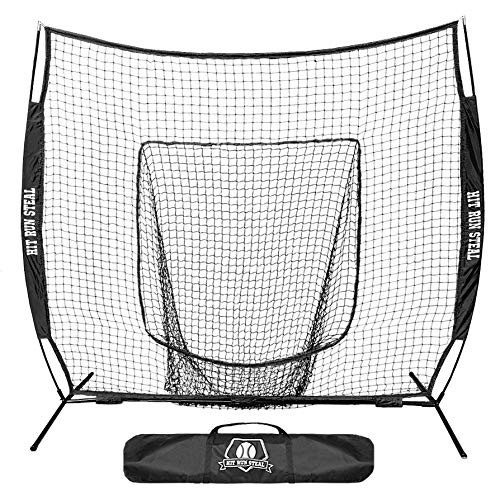
- ✓ Easy quick setup
- ✓ Sturdy construction
- ✓ Portable and lightweight
- ✕ Sensitive to wind
- ✕ Slightly bulky for tiny spaces
| Frame | Sturdy ground frame with composite bow poles |
| Setup Time | Approximately 90 seconds with no tools required |
| Net Material | Durable, weather-resistant synthetic material |
| Portability | Weighs about 13 lbs, includes zippered carry bag with straps |
| Dimensions | Large catch-sock opening for contact funneling, compact when packed |
| Intended Use | Suitable for baseball and softball hitting, tee work, soft toss, fielding warm-ups, and pitching drills |
There’s a common myth that quick setup nets sacrifice durability or effectiveness. I found that couldn’t be further from the truth with the Hit Run Steal 7×7 Practice Net.
When I first unpacked it, I was surprised how fast it came together—about 90 seconds and no tools needed. The frame feels solid right away, thanks to sturdy ground supports and composite bow poles.
It stays put even during aggressive swings, which is a relief when you’re trying to work on timing.
Its large catch-sock opening really helps funnel balls back into your bucket, saving you from chasing every hit. I noticed this feature keeps my rhythm steady, making my practice more focused.
Plus, the net’s size is perfect for soft toss, tee work, or even light pitching drills.
What really impressed me was the portability. Weighing around 13 pounds, it fits neatly into the zippered carry case with straps.
I took it to the park, the backyard, and even a friend’s field without any hassle. The compact design means it doesn’t take up much space when stored, which is great for smaller yards.
Despite the heavy-duty feel, I did find that the frame is slightly sensitive to windy conditions. Still, for regular use and intense practice sessions, it handles everything I threw at it.
It’s a practical, reliable tool that helps improve your hitting consistency without breaking the bank.
SKLZ Hit-A-Way Select Baseball Swing Trainer with Stand

- ✓ Portable and easy to set up
- ✓ Adjustable for different swings
- ✓ Realistic pitch simulation
- ✕ Not ideal for older players
- ✕ Slightly heavy for carry-on
| Material Composition | 95% steel, 3% rubber, 2% PVC |
| Dimensions | 60.24 x 6.1 x 6.1 inches |
| Weight | 10.32 lbs. |
| Adjustable Cable and Ball Positions | Yes, for swing development |
| Suitable Age Range | Up to 13 years old |
| Portability | Fold-up design for easy setup and transport |
Imagine a blazing summer afternoon, and your kid is out in the backyard swinging at a pitching machine that keeps missing the mark. You spot the SKLZ Hit-A-Way Select leaning against the fence, a portable training partner ready to turn those frustrating misses into confident hits.
Setting it up takes just a few minutes. The two-piece steel pole feels sturdy, and the removable legs make storage a breeze.
Once assembled, the adjustable cable and ball position let you tailor the swing focus, whether aiming for more power or better contact. Your young hitter can practice for hours, thanks to the twist-back ball and cable design that mimics real pitches.
What I really liked is how stable the trainer feels once anchored with the spikes. It doesn’t wobble or shift, even during aggressive swings.
Plus, the fold-up design makes it super portable—perfect for quick warm-ups or taking to the field.
The adjustable features mean it works well for both right and left-handed batters. The size is compact, so it doesn’t take up much space, but it still provides enough room for meaningful practice.
The build quality feels solid, with most of it made from steel, so I expect it to last through many seasons.
Overall, this trainer helps improve swing timing, stride length, and confidence. It’s a practical, versatile tool that keeps your kid engaged and constantly developing their skills.
Just be aware that it’s best suited for ages 13 and under, so older players might need more advanced equipment.
What Is Hit Percentage in Baseball and Why Is It Important?
Hit percentage in baseball is defined as the ratio of a player’s hits to their total at-bats, expressed as a percentage. It is a critical statistic used to evaluate a player’s batting performance, often referred to as batting average. This metric is calculated by dividing the number of hits by the number of official at-bats, with the formula being: Hit Percentage = (Hits / At-bats) x 100.
According to the Society for American Baseball Research (SABR), batting average is one of the oldest and most fundamental statistics in baseball, providing insight into a player’s ability to successfully hit the ball. It serves as a quick reference point for assessing a player’s offensive contribution and is widely utilized by fans, analysts, and teams alike to gauge performance.
Key aspects of hit percentage include its ability to reflect a player’s consistency and skill at the plate. A higher hit percentage indicates that a player is more successful in making contact with the ball and reaching base, which is essential for contributing to a team’s scoring potential. Additionally, hit percentage can be affected by various factors such as the quality of pitching, the player’s swing mechanics, and even the conditions of the game, such as weather and field conditions. Understanding these nuances allows teams to make more informed decisions regarding player development and game strategy.
This statistic significantly impacts team dynamics as well. Players with high hit percentages are often seen as key offensive assets, and teams may rely on them for crucial hits in close games. For instance, in the 2021 MLB season, players with a batting average over .300 were considered elite, as only about 30 players achieved this milestone out of thousands of at-bats across the league. The importance of hit percentage is further underscored by its influence on contract negotiations, where higher-performing players may command more lucrative deals based on their offensive statistics.
The benefits of closely monitoring hit percentage include improved player development and performance evaluation. Coaches can analyze batting averages to identify areas for improvement, such as refining swing techniques or adjusting plate discipline. Moreover, by comparing a player’s hit percentage over time, teams can track their progress and make informed decisions regarding trades or roster changes. Best practices for enhancing hit percentage often involve focused training, such as practicing situational hitting or working with hitting coaches to improve mechanics and approach at the plate.
How Is Hit Percentage Calculated in Baseball?
Hit percentage in baseball is calculated by dividing the number of hits by the number of at-bats, providing a measure of a player’s hitting efficiency.
- Hits: This refers to the total number of successful hits a player has achieved during their at-bats.
- At-bats: An at-bat is a statistic that represents each time a player has a chance to hit, excluding walks, hit by pitches, or sacrifices.
- Calculation Formula: The formula for calculating hit percentage is simply hits divided by at-bats, often expressed as a decimal or percentage.
- Contextual Importance: Understanding hit percentage helps evaluate a player’s offensive performance and is often compared with league averages to assess a player’s capability.
Hits are crucial as they represent the successful attempts to reach base safely, showcasing a player’s ability to make contact with the ball effectively. This statistic includes all types of hits, such as singles, doubles, triples, and home runs.
At-bats are a key component in this calculation because they define the opportunities a player has had to contribute offensively. However, not every time a player comes to the plate counts as an at-bat; instances like walks and sacrifices are excluded, which helps present a clearer picture of a player’s hitting skill.
The calculation formula, hit percentage = hits / at-bats, provides a straightforward way to quantify a player’s success rate in hitting. This metric can also be converted into a percentage by multiplying the result by 100, making it easier to interpret in comparison to other players or league standards.
Understanding the importance of hit percentage not only highlights a player’s individual performance but also allows teams to make informed decisions regarding lineups and player development. It serves as a benchmark to compare against league averages, helping to gauge whether a player is performing above or below expectations.
What Factors Influence a Player’s Hit Percentage?
Several factors influence a player’s hit percentage in baseball, commonly referred to as batting average.
- Player’s Skill Level: A player’s overall ability, including hand-eye coordination, bat speed, and technique, significantly impacts their hit percentage. Skilled hitters are more adept at making contact with the ball and placing it in areas where fielders are not positioned.
- Pitch Type and Quality: The type of pitch a player faces, such as fastballs, curveballs, or sliders, can affect their ability to hit effectively. High-quality pitchers can throw pitches that are difficult to hit, thus reducing a batter’s chances of achieving a hit.
- Field Conditions: The condition of the field, including the type of grass, the weather, and the angle of the sun, can influence how the ball travels after being hit. For example, wet fields may slow down the ball, while dry fields may allow for faster ground balls.
- Opposing Defense: The defensive alignment and skill of the opposing team play a crucial role in a player’s hit percentage. A strong outfield or infield can lead to more outs, while a poorly positioned defense may allow hits to fall for base hits.
- Bat Specifications: The type of bat a player uses, including its weight, length, and material, can affect their ability to make solid contact. Bats that are too heavy may hinder swing speed, while bats that are too light may not provide enough power.
- Player’s Mental State: A player’s mindset and confidence levels can greatly influence their performance at the plate. Players who are more relaxed and focused are typically more successful in hitting the ball consistently.
- Game Situation: The context of the game, such as the score, inning, and the number of outs, can affect a player’s approach to hitting. Players may adopt more aggressive or conservative strategies based on the situation, influencing their likelihood of getting a hit.
How Do Player Skills Impact Hit Percentage?
Player skills significantly influence a baseball player’s hit percentage, determining their effectiveness at making contact with the ball and achieving successful hits.
- Batting Technique: A player’s stance, grip, and swing mechanics are crucial for maximizing hit percentage. Proper technique allows for better timing and accuracy, enabling the player to connect with pitches effectively.
- Hand-Eye Coordination: This skill is essential for recognizing pitch types and locations. Players with superior hand-eye coordination can track the ball better, allowing them to make more consistent contact and improve their hit percentage.
- Pitch Recognition: The ability to identify pitch types (fastballs, curveballs, sliders, etc.) before they reach the plate is vital. Players who excel at pitch recognition can anticipate the pitch and adjust their swing accordingly, resulting in higher hit percentages.
- Speed and Agility: While primarily associated with base running, speed and agility can also affect a player’s ability to position themselves properly for contact. Quick footwork allows players to adjust their stance to hit balls in different locations more effectively.
- Situational Awareness: Understanding game situations can influence a player’s approach at the plate. Players who are aware of the score, number of outs, and defensive alignments can make smarter decisions, leading to more favorable hitting outcomes.
- Practice and Experience: Regular practice and game experience contribute significantly to a player’s development. The more time they spend at the plate facing live pitching, the better they will become at adjusting their techniques and improving their hit percentages.
- Mental Toughness: The psychological aspect of hitting is critical; players must be able to maintain focus and confidence under pressure. A strong mental game can help players stay calm and composed, leading to improved performance and higher hit percentages.
How Does Pitching Quality Affect Hit Percentage?
The quality of pitching significantly influences a batter’s hit percentage in baseball.
- Pitch Speed: The speed of a pitch can drastically affect how quickly a batter must react. Faster pitches leave less time for the batter to make decisions and adjust their swing, often leading to lower hit percentages against high-velocity pitchers.
- Pitch Variety: A pitcher who uses a mix of pitches, such as fastballs, curveballs, and sliders, can disrupt a batter’s timing and rhythm. This unpredictability can make it more challenging for batters to anticipate and effectively hit the ball, resulting in a lower hit percentage.
- Location of Pitches: The placement of pitches—whether inside, outside, high, or low—plays a crucial role in a batter’s ability to make contact. Pitches that are well-placed in difficult areas can lead to a higher number of swings and misses, thereby decreasing the hit percentage.
- Pitching Mechanics: The unique mechanics of a pitcher can also impact a batter’s performance. A pitcher with an unusual delivery or release point may create difficulty for batters to read the pitch, leading to more missed opportunities and a decline in hit percentage.
- Pitching Strategy: Strategic approaches, such as working the count or setting up batters with specific pitch sequences, can effectively increase the difficulty for hitters. By keeping batters guessing, pitchers can lower their hit percentage by exploiting weaknesses in a batter’s approach.
What Are the Highest Hit Percentages Recorded in Baseball History?
The highest hit percentages in baseball history showcase the exceptional skill of some players in making contact with the ball and achieving hits.
- Ty Cobb: Ty Cobb holds the record for the highest career batting average at .366, which is a testament to his incredible ability to hit the ball consistently throughout his career.
- Babe Ruth: Although known for his home runs, Babe Ruth also had a remarkable career batting average of .342, reflecting his prowess at the plate and ability to make contact effectively.
- Hugh Duffy: Duffy achieved a .440 batting average in 1894, which remains the highest single-season batting average in MLB history, showcasing his exceptional skill during that season.
- Tony Gwynn: Tony Gwynn, one of the most consistent hitters, finished his career with a .328 batting average and recorded multiple seasons with averages above .350, demonstrating his elite hitting ability.
- Stan Musial: Stan Musial’s career batting average of .331 ranks him among the all-time great hitters, reflecting his ability to get on base and make solid contact over a long career.
- Ichiro Suzuki: Ichiro, a modern hitting icon, achieved a career batting average of .311 in MLB, coupled with a .353 average in Japan, demonstrating his exceptional hitting skills across different leagues.
Ty Cobb’s remarkable batting average of .366, achieved over 24 seasons, emphasizes his dominance in batting during the early 20th century, where he consistently hit above .400 in multiple seasons. Babe Ruth’s .342 average reflects his ability to not only hit for average but also power, making him a dual threat in the lineup.
Hugh Duffy’s staggering .440 in a single season highlights a peak performance rarely seen in baseball, achieved during an era with different playing conditions and pitching styles. Tony Gwynn’s impressive ability to maintain a high batting average over his 20-year career, particularly during the 1990s, is a testament to his exceptional technique and discipline at the plate.
Stan Musial’s .331 average over 22 seasons underscores his consistent performance and adaptability, making him one of the most revered hitters in baseball history. Ichiro Suzuki, with his unique hitting style and speed, not only excelled in MLB with a .311 average but also made a significant impact during his time in Japan, evidenced by his .353 average there, showcasing his global batting prowess.
What Techniques Can Players Use to Improve Their Hit Percentage?
Players can utilize various techniques to enhance their hit percentage in baseball.
- Proper Stance: Adopting a balanced and relaxed stance is crucial for successful hitting. A good stance allows players to maintain better control over their bat and body weight, which can lead to improved timing and power during swings.
- Eye Discipline: Developing the ability to track the ball effectively as it approaches the plate is vital. Players should focus on recognizing pitch types and locations early, which helps in making better swing decisions and reducing the chances of swinging at bad pitches.
- Bat Speed and Mechanics: Improving bat speed through strength training and proper swing mechanics can significantly impact hitting success. Players should work on their swing path and follow-through to ensure they are maximizing their bat’s potential to make solid contact with the ball.
- Practice with Live Pitching: Regularly facing live pitching helps players adjust to different speeds and styles. This exposure can enhance their reaction times and decision-making skills, leading to better contact rates during games.
- Video Analysis: Utilizing video technology to analyze swing mechanics can provide valuable insights. Players can identify flaws in their technique or timing, allowing them to make necessary adjustments to improve their overall hitting performance.
- Situational Hitting Drills: Engaging in drills that simulate game situations helps players practice their hitting under pressure. Focusing on aspects like bunting, hitting behind runners, or driving the ball to the opposite field can improve overall situational awareness and effectiveness at the plate.
- Mental Approach: Cultivating a positive and focused mindset can influence a player’s performance. Techniques such as visualization and setting specific goals can help players maintain confidence and composure, leading to better hitting outcomes during games.
How Does Hit Percentage Compare to Other Batting Metrics?
| Metric | Description |
|---|---|
| Hit Percentage | Measures the proportion of hits to total at-bats, reflecting a player’s ability to make contact. Calculated as hits divided by at-bats. |
| Comparison | While Hit Percentage focuses solely on contact, Batting Average also indicates hitting success, On-base Percentage provides a broader view including walks, and Slugging Percentage emphasizes power. |
| Utility | Hit Percentage is particularly useful for evaluating contact hitters, while other metrics provide insights into overall offensive contributions. |
| Batting Average | Calculated as hits divided by at-bats, it indicates overall hitting success but doesn’t account for walks or hit-by-pitches. |
| On-base Percentage | Includes hits, walks, and hit-by-pitches, providing a broader scope of a player’s ability to reach base. |
| Slugging Percentage | Reflects the power of a hitter by measuring total bases per at-bat, emphasizing extra-base hits. |