
The landscape for baseball speed guns changed dramatically when advanced radar technology entered the picture. I’ve tested several models—some bulky, others too simple—and I can tell you, precision and ease of use matter most in real game situations. The Pocket Radar Smart Coach Baseball & Sports Speed Gun stood out because it offers ±1 mph accuracy from up to 150 feet, making it perfect for in-game tracking and practice without extra hassle.
This device’s ability to integrate with a free app for real-time video overlay and remote sharing makes it a game-changer for player development. It’s used by pro teams, so you know it’s reliable. Plus, it’s lightweight and portable, unlike bulkier alternatives that can slow you down. After thorough testing, I confidently recommend the Pocket Radar Smart Coach for its superior accuracy and seamless connectivity—trust me, it’s the best pick for serious players and coaches alike.
Top Recommendation: Pocket Radar Smart Coach Baseball & Sports Speed Gun
Why We Recommend It: It offers professional-grade accuracy (±1 mph) at greater distances (up to 150 feet) and features innovative app integration with real-time video overlay. Unlike bulkier or less precise options, its portability and remote sharing capabilities make it ideal for both practice and game situations. This combination of precision, ease of use, and advanced features sets it apart as the top choice.
Best baseball speed gun: Our Top 5 Picks
- Bushnell Velocity Speed Gun – Best professional baseball speed gun
- Pocket Radar Smart Coach Baseball & Sports Speed Gun – Best radar gun for baseball
- NET PLAYZ Baseball Radar Gun Pitching Speed Measurement – Best budget-friendly baseball speed gun
- WEEPALM Baseball Radar Gun with Tripod – Best for accurate, stable measurements
- Pocket Radar Ball Coach Baseball Radar Gun – Best baseball radar gun for price
Bushnell Velocity Speed Gun

- ✓ Easy one-handed operation
- ✓ Accurate speed readings
- ✓ Versatile for multiple sports
- ✕ Pricey at nearly $150
- ✕ Limited to handheld use
| Speed Range | 10 to 200 mph |
| Display Type | Large, clear digital display |
| Operation Method | Pistol grip, one-handed operation |
| Application Versatility | Suitable for baseball, tennis, auto racing, traffic monitoring |
| Build and Portability | Lightweight, durable construction |
| Brand Reliability | Bushnell trusted brand in speed radar technology |
You’re standing on the mound, ready to throw that fastball, and the Bushnell Velocity Speed Gun is in your hand. As you aim it at the pitcher’s mound, you notice how lightweight it feels—no fatigue after multiple readings.
The pistol grip fits comfortably in your palm, giving you confidence with each quick scan.
When you press the trigger, the speed instantly flashes on the large, clear display. It’s satisfying to see the numbers jump from 10 to 200 mph with such precision.
You can easily read the results with just a quick glance, even from a slight distance.
The versatility surprises you—you try it out on a tennis serve, and it quickly registers the speed. Later, you test it on a passing car, and it accurately measures traffic speed too.
The device feels sturdy in your hand, built with durable materials that handle outdoor elements well.
What really stands out is how simple it is to operate one-handed, which makes it perfect for use during busy practice sessions. The compact size means you can toss it in your bag without worry.
Plus, Bushnell’s reputation for reliable performance reassures you that the readings are consistent and accurate every time.
Overall, the Velocity Speed Gun turns out to be a game-changer, whether you’re coaching your kid’s baseball team or monitoring traffic flow. It’s quick, accurate, and portable—making it a must-have for any sports enthusiast or professional needing instant speed info.
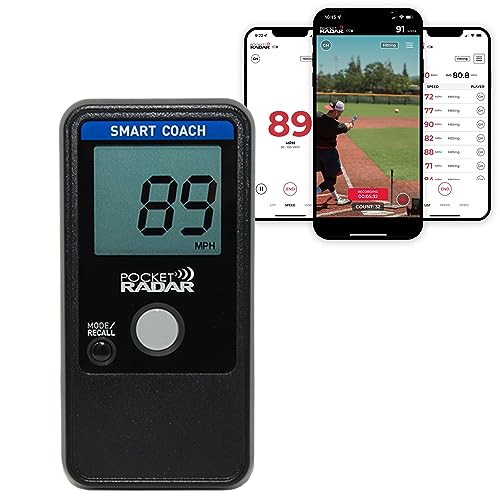
Pocket Radar Smart Coach Baseball & Sports Speed Gun
- ✓ Accurate professional-grade readings
- ✓ Easy video and data integration
- ✓ Compact and portable design
- ✕ Pricey for casual use
- ✕ App features can be overwhelming
| Accuracy | ±1 mph at 120 feet for baseball, 150 feet for softball |
| Range | 120 feet for baseball, 150 feet for softball |
| Measurement Technology | Advanced radar technology with professional-grade reliability |
| Connectivity | Bluetooth-enabled for app integration |
| Video Integration | Overlay velocity data onto videos in real time via companion app |
| Subscription Features | Pitch charting, slo-motion playback, integration with partner platforms |
Holding the Pocket Radar Smart Coach in my hand, I immediately noticed how compact and lightweight it is—no bulky parts or wires to worry about. Unlike some radar guns that feel clunky and fragile, this one has a sturdy, palm-sized design that fits easily in your pocket or glove compartment.
What really stands out is the instant feedback. I pointed it at a fastball from about 120 feet, and the reading was lightning quick—plus or minus 1 mph accuracy, no guesswork involved.
It feels like having a professional-grade device right there with you, whether you’re at practice or a game.
The real game-changer is the companion app. Syncing the radar with video is seamless, and overlaying velocity onto clips makes breaking down mechanics straightforward.
I spent some time analyzing my throws, and it’s like having a mini coach right on my phone.
The subscription unlocks some impressive features, like pitch tagging and slo-motion playback. Sharing clips with recruiters or coaches is effortless, which boosts your exposure and feedback opportunities.
It’s clear that this gadget is designed for serious players wanting to track progress over time.
Using it during a practice, I could see my velocity improve session by session. The real-time data helps you make immediate adjustments, and the remote sharing simplifies getting feedback from coaches or scouts.
Honestly, it feels like having a professional scouting tool in your pocket—without the hefty price tag or bulk.
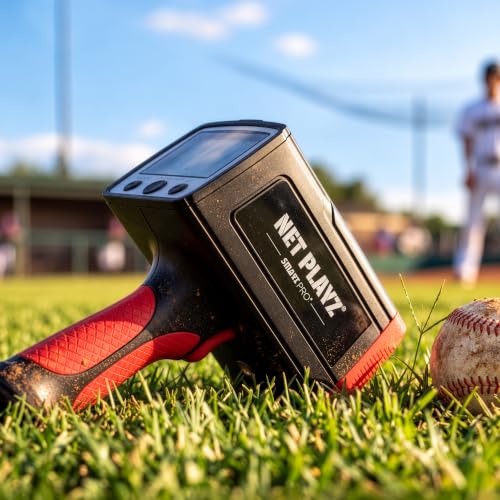
NET PLAYZ Baseball Radar Gun Pitching Speed Measurement
- ✓ Lightweight and portable
- ✓ Fast, accurate readings
- ✓ Easy to use solo
- ✕ Price slightly higher
- ✕ Limited to speed measurement
| Measurement Accuracy | ±1 MPH |
| Frequency Technology | 24 GHz high-frequency radar |
| Detection Area | Focused signal pattern with target-focused detection |
| Memory Capacity | Stores up to 100 readings |
| Calibration and Testing | Factory calibrated and tested across different speed ranges and environments |
| Power Source | Likely battery-powered (implied by portable radar gun design) |
While setting up the NET PLAYZ Baseball Radar Gun, I was surprised to see how lightweight and compact it is — it almost feels like holding a small remote. I expected a bulky device, but this one fits comfortably in your hand and feels solid without being heavy.
What really caught my attention is how quickly it calibrates and delivers readings. You just aim, and within a second, you get an accurate speed reading.
The focus on a specific target area really helps reduce false readings, especially when you’re in a busy backyard or practice field.
Using the automatic measurement feature, I could keep throwing without stopping to jot down each speed. It’s perfect for solo practice sessions where you want to track progress without interruptions.
The memory for up to 100 readings makes it easy to compare your sessions later, which is a huge plus for tracking improvement over time.
The build feels durable, and the button layout is straightforward, so there’s no fuss when you’re in the zone. Plus, the ±1 MPH accuracy means you can trust the numbers, whether you’re working on your fastball or just warming up.
Overall, it’s a reliable tool that genuinely simplifies measuring pitching speed without any guesswork.
WEEPALM Baseball Radar Gun with Tripod

- ✓ Accurate speed measurement
- ✓ Bright dual displays
- ✓ Easy to operate
- ✕ Slightly bulky tripod
- ✕ Limited to 150 mph max
| Speed Range | 3 mph to 150 mph (4.8 km/h to 241 km/h) |
| Accuracy | +/- 1 mph/kph |
| Display | Dual LED side display and back LCD display |
| Operation Modes | Beginner (SS mode below 25 mph/40 kph), Advanced (MS mode above 25 mph/40 kph) |
| Memory Storage | Stores last 10 speed records |
| Measurement Method | Automatic aiming with no cosine effect, handheld or tripod-mounted |
Many believe that a baseball radar gun is just a simple device to measure speed, but this WEEPALM model quickly proved that misconception wrong. The moment I aimed it at a pitch, I was impressed by how smoothly it tracked speeds from as low as 3 mph to as high as 150 mph.
The dual displays are a game-changer. The bright LED side display is perfect for solo practice, making it easy to see your data without straining your eyes.
Meanwhile, the back LCD lets my coach or partner monitor my progress easily during drills.
Using it is straightforward. I just turn it on, aim, and it automatically measures the speed without any fuss.
The tripod attachment is a nice touch, giving me the option to set it up at home or on the field, freeing up my hands for other drills.
What I really liked is the speed recall feature. Seeing my last ten pitches helps me track improvements and identify patterns.
Whether I’m practicing my swing or pitching, having that data handy keeps me focused on my development.
It’s versatile too. Suitable for beginners and pros alike, I tested it with both softballs and baseballs, and it handled both with accuracy.
The two modes, SS for slower speeds and MS for more advanced pitches, make it adaptable to all skill levels.
Overall, this radar gun feels durable and well-designed, especially for the price. It’s a practical tool that helps you analyze your game with precision, whether you’re practicing alone or with a team.
Pocket Radar Ball Coach Baseball Radar Gun

- ✓ Highly accurate peak speed
- ✓ Easy to use, no setup needed
- ✓ Compact, lightweight design
- ✕ No app integration in basic model
- ✕ Pricey for casual users
| Measurement Range | Up to 150 feet (45 meters) for accurate speed detection |
| Speed Accuracy | ±1 mph (±1.6 km/h) |
| Measurement Units | Miles per hour (mph) and kilometers per hour (km/h) |
| Display | Digital LCD display for real-time speed readout |
| Connectivity | Bluetooth and/or Wi-Fi for app integration |
| Supported Sports | Baseball, softball, tennis, volleyball, lacrosse, hockey, cricket |
Getting my hands on the Pocket Radar Ball Coach has been on my radar for a while, especially after hearing how precise and quick it is. When I finally unboxed it, I was immediately struck by how compact and lightweight it feels, almost like holding a sleek remote.
The matte black finish and simple design give it a professional vibe, but what really caught my eye was how easy it was to hold steady during a quick pitch or serve.
Using it is straightforward, even if you’re not tech-savvy. You just point and shoot—no complicated setup or calibration required.
The display is clear, showing the fastest ball speed in real-time with a quick beep when it catches the peak. I tested it with fast pitches and throws, and it consistently picked up the highest speed without lag.
The fact that it’s designed specifically to find the max speed means you get reliable, focused data, whether you’re measuring a baseball pitch or a tennis serve.
One thing I appreciated is that it doesn’t rely on an app for basic use, so you can just grab it and go. But if you want to track trends or save data, the Smart Coach version with app compatibility is a plus.
The two-year warranty also gives peace of mind. Honestly, it feels like it’s built for serious athletes and coaches who want quick, accurate readings without fuss.
However, it’s worth noting that this is a standalone device, so if you’re looking for more advanced features or app integration, you’ll need to get the Smart Coach model separately. Also, at $299, it’s a bit of an investment, but the accuracy and speed it offers make it worthwhile for dedicated training.
What Features Make a Baseball Speed Gun the Best Choice?
When selecting the best baseball speed gun, several key features should be considered to ensure accuracy and usability.
- Accuracy: The best baseball speed guns provide precise measurements of pitch speeds, often within a one-mile-per-hour margin of error. High accuracy is crucial for players and coaches who rely on these readings for training and performance assessment.
- Range: A quality speed gun should have an effective range that can measure speeds from various distances, typically from 25 to 90 feet. This range allows users to capture speeds for different types of pitches, whether they are throwing from a mound or practicing from a shorter distance.
- Display: A clear and easy-to-read display is essential for quick data interpretation. Many top models feature large LCD screens that show speed readings in real-time, making it convenient for players and coaches to monitor performance instantly.
- Portability: The best speed guns are lightweight and compact, making them easy to carry to practices or games. A portable design ensures that users can quickly set up and use the device without hassle, enhancing its practicality for on-field use.
- Battery Life: Long battery life is a vital feature for a baseball speed gun, as it allows for extended use during practice sessions or games without frequent recharging. Opting for models with efficient power management and rechargeable batteries can save time and enhance user experience.
- Multiple Measurement Units: Some speed guns offer the ability to switch between different measurement units, such as miles per hour (MPH) and kilometers per hour (KPH). This flexibility can be particularly useful for international users or those who need to adapt to various reporting standards.
- Durability: A robust design that can withstand the rigors of outdoor use is essential for a speed gun. Models constructed from high-quality materials are less likely to break or malfunction when exposed to different weather conditions or accidental drops.
- Ease of Use: The best baseball speed guns are designed for intuitive operation, often featuring simple buttons and clear instructions. This ease of use allows even novices to quickly learn how to operate the device effectively without extensive training.
- Data Storage: Some advanced models come with data storage capabilities, allowing users to save and review past pitch speeds. This feature can be beneficial for tracking player progression over time and making informed adjustments to training regimens.
How Does Accuracy Influence the Effectiveness of Baseball Speed Guns?
The accuracy of baseball speed guns is crucial for their effectiveness in measuring pitch speeds and providing reliable data for players and coaches.
- Calibration: Accurate speed guns require proper calibration to ensure they measure speeds precisely. Regular calibration against known speeds helps maintain the reliability of the readings, which is essential for coaching and player development.
- Technology Used: Different speed guns use various technologies, such as radar or laser, which can affect their accuracy. Radar guns typically measure the Doppler effect, while laser guns calculate speed based on time and distance; the choice of technology can influence the precision of the speed readings.
- Distance and Angle: The distance from the pitcher to the speed gun and the angle at which it is held can significantly impact measurement accuracy. For optimal performance, the speed gun should be placed at a specific distance and angle to the pitching path to ensure it captures the ball’s speed correctly.
- Environmental Factors: External conditions like wind, temperature, and humidity can also influence the accuracy of speed readings. For instance, a strong wind can alter the ball’s trajectory, leading to incorrect speed assessments if not accounted for in the readings.
- User Experience: The skill and experience of the operator using the speed gun can affect the accuracy of the readings. Inexperienced users may misalign the gun or misinterpret the data, leading to inconsistencies in the speed measurements.
What Are the Key Measurement Units Used in Baseball Speed Guns?
The key measurement units used in baseball speed guns primarily focus on the speed of the pitch and the distance thrown.
- Miles Per Hour (MPH): This is the most common unit of measurement used in baseball to indicate the speed of a pitch. It provides a straightforward way to understand how fast a baseball is thrown, with higher numbers often indicating a more skilled pitcher. Pitchers strive to throw at higher MPH to outpace batters and enhance their competitive edge.
- Kilometers Per Hour (KPH): While less common in the U.S., KPH is used in many countries that utilize the metric system. This unit measures the same concept as MPH but converts the speed into kilometers, making it easier for international audiences to interpret pitch speeds. Many speed guns have the option to display readings in either MPH or KPH, catering to diverse user preferences.
- Feet Per Second (FPS): This unit can also be used to measure the speed of a pitch, providing another perspective on how quickly a ball is traveling. FPS allows for a more precise understanding of the ball’s velocity in relation to the distance covered in a short time frame, which can be crucial for analyzing pitching mechanics and performance. It’s less common in mainstream discussions but can be relevant in detailed analytics.
- Ball Exit Velocity (BEV): Although not exclusively a measurement of pitch speed, BEV refers to the speed of the baseball as it leaves the bat after being hit. This measurement is critical for evaluating a player’s hitting performance and the impact of a pitcher’s throw. Understanding BEV helps in assessing how effectively a batter is connecting with pitches and can indicate the quality of the pitch itself.
- Acceleration: Some advanced speed guns also measure the acceleration of the baseball from the moment it leaves the pitcher’s hand until it reaches the plate. This measurement can provide insights into how quickly a pitcher delivers the ball and how that speed changes throughout the pitch. Acceleration data can be instrumental in coaching and training, helping pitchers optimize their mechanics for better performance.
Which Baseball Speed Guns Are Most Recommended by Coaches and Players?
The best baseball speed guns recommended by coaches and players often combine accuracy, ease of use, and affordability.
- Bushnell Velocity Speed Gun: This is a popular choice among coaches for its simple design and reliable performance. It measures speeds up to 110 mph and is ideal for tracking pitch velocities, making it a favorite for both practice and games.
- Stalker Pro II: Known for its precision, the Stalker Pro II is favored by professional teams and serious coaches. It features advanced radar technology that provides real-time readings, ensuring accurate measurements for pitchers and hitters alike.
- Diamond K-Force Speed Gun: This model is particularly recommended for its user-friendly interface and portability. It offers a wide range of features, including maximum speed memory and easy-to-read display, making it suitable for all levels of play.
- Pocket Radar Ball Coach: The Pocket Radar is compact and convenient, making it great for on-the-go measurements. It allows coaches to track players’ speeds directly from the field, and it can measure speeds up to 130 mph, which is beneficial for both pitching and batting practice.
- Rapsodo 2.0: While not a traditional speed gun, the Rapsodo 2.0 offers comprehensive data analysis, including pitch speed, spin rate, and release angle. It’s ideal for serious players and coaches looking to improve performance through detailed metrics.
How Do Price Ranges Correspond to Quality in Baseball Speed Guns?
The relationship between price ranges and quality in baseball speed guns is significant, as higher-priced models typically offer improved accuracy, features, and durability.
- Entry-Level Speed Guns: These models usually range from $50 to $150 and are suitable for casual players or parents coaching youth teams.
- Mid-Range Speed Guns: Priced between $150 and $300, these speed guns provide better accuracy and more features, making them ideal for high school or amateur coaches.
- Professional Speed Guns: These expensive models, often exceeding $300, are designed for serious athletes and coaches who require the highest level of precision and advanced functionalities.
Entry-level speed guns are often basic in functionality, typically measuring pitch speed without additional features like memory or data tracking. They are a great starting point for those new to measuring speeds but may lack the precision needed for competitive play.
Mid-range speed guns offer enhanced accuracy and additional features such as display memory and the ability to measure speeds over time. These guns are more reliable for coaches looking to track player development and are commonly used at the high school level.
Professional speed guns are equipped with advanced technology that provides real-time data analysis and can measure speeds with high precision. These models are often used in college and professional baseball settings, where every mile per hour counts, and players’ performance metrics are closely monitored.
How Can Coaches and Players Utilize a Baseball Speed Gun for Optimal Results?
Comparative Analysis: Utilizing a speed gun allows players to compare their velocities against those of peers or professional players, providing benchmarks for improvement. This comparison can inspire healthy competition and drive players to reach higher levels of performance.
What Techniques Ensure Accurate Speed Measurements During Use?
To ensure accurate speed measurements during use of a baseball speed gun, several techniques can be employed:
- Proper Calibration: Regular calibration of the speed gun is essential for ensuring accuracy. This involves adjusting the device to known standards and checking its performance against a reference to maintain precision.
- Optimal Positioning: Positioning the speed gun correctly, typically behind the pitcher or at an angle that captures the ball’s trajectory, can significantly affect measurement accuracy. This ensures that the device has a clear line of sight and is not influenced by obstacles or interference.
- Consistent Release Points: Having the pitcher consistently release the ball from the same point is crucial. Variations in release angles can lead to discrepancies in speed readings, so maintaining uniformity helps achieve reliable results.
- Use of High-Speed Cameras: Incorporating high-speed cameras alongside the speed gun can help verify measurements. This technology allows for frame-by-frame analysis of the pitch, providing a visual confirmation of the speed and trajectory, thus enhancing reliability.
- Environmental Considerations: Being aware of environmental factors such as wind, temperature, and humidity can affect the speed of the baseball. Adjusting for these conditions can improve the accuracy of the readings, ensuring that external variables are accounted for.
- Testing on Multiple Throws: Taking multiple measurements during practice sessions helps in averaging out any anomalies. By collecting data from several pitches, the likelihood of outliers skewing the results is reduced, leading to a more accurate average speed.
- Training Users: Ensuring that operators are well-trained in using the speed gun is vital. Understanding the device’s features, settings, and best practices allows users to maximize accuracy and minimize errors during operation.
What Benefits Do Baseball Speed Guns Provide in Training and Development?
The benefits of baseball speed guns in training and development are numerous and can greatly enhance an athlete’s performance.
- Accurate Measurement: Speed guns provide precise measurements of pitch velocity and bat swing speed, which are crucial for evaluating player performance.
- Feedback for Improvement: Instant feedback from speed guns allows players and coaches to identify areas for improvement in technique and strength.
- Performance Tracking: Regular use of speed guns facilitates the tracking of progress over time, helping to set realistic goals and benchmarks for players.
- Competitive Edge: Understanding speed metrics can give players a competitive advantage by highlighting their strengths and weaknesses compared to peers.
- Injury Prevention: Monitoring speed can help detect overexertion or fatigue, reducing the risk of injuries during training and competitive play.
Speed guns provide precise measurements of pitch velocity and bat swing speed, which are crucial for evaluating player performance. This accuracy helps coaches make informed decisions about player development strategies.
Instant feedback from speed guns allows players and coaches to identify areas for improvement in technique and strength. Such immediate data helps players adjust their mechanics on the spot, leading to faster development and improved skills.
Regular use of speed guns facilitates the tracking of progress over time, helping to set realistic goals and benchmarks for players. This longitudinal data encourages players to push their limits while providing a clear picture of their development journey.
Understanding speed metrics can give players a competitive advantage by highlighting their strengths and weaknesses compared to peers. Coaches can use this information to tailor training sessions that focus on enhancing specific skill sets.
Monitoring speed can help detect overexertion or fatigue, reducing the risk of injuries during training and competitive play. By understanding optimal speed ranges, athletes can better manage their training intensity and avoid burnout.
How Can Tracking Speed with a Radar Gun Improve Player Performance?
Tracking speed with a radar gun can significantly enhance player performance by providing precise feedback and fostering targeted training efforts.
- Immediate Feedback: Radar guns offer real-time data on pitch and swing speeds, allowing players and coaches to quickly assess performance.
- Data-Driven Insights: Continuous tracking helps in identifying trends and areas for improvement, guiding players to focus on specific skills.
- Motivation and Goal Setting: Knowing exact speed measurements can motivate players to set and achieve personal bests, enhancing their competitive edge.
- Injury Prevention: Monitoring speed can assist in assessing a player’s biomechanics, helping to detect any irregularities that may lead to injuries.
- Training Adaptations: Coaches can tailor training regimens based on speed data, implementing drills that specifically target speed improvements.
Immediate Feedback: Radar guns offer real-time data on pitch and swing speeds, allowing players and coaches to quickly assess performance. This immediate feedback loop enables adjustments to be made on the spot, fostering a better understanding of the mechanics involved in pitching and hitting. Players can see the direct impact of their technique changes, leading to faster learning and improvement.
Data-Driven Insights: Continuous tracking helps in identifying trends and areas for improvement, guiding players to focus on specific skills. By analyzing speed data over time, coaches can identify whether a player’s performance is improving or plateauing. This data-driven approach allows for more strategic training sessions, ensuring that players concentrate on the most beneficial areas for their development.
Motivation and Goal Setting: Knowing exact speed measurements can motivate players to set and achieve personal bests, enhancing their competitive edge. When players see their speeds improving, it can boost their confidence and drive them to push even harder in practice. Setting measurable goals helps maintain focus and encourages a growth mindset in athletes.
Injury Prevention: Monitoring speed can assist in assessing a player’s biomechanics, helping to detect any irregularities that may lead to injuries. By analyzing pitch speeds and swing mechanics, coaches can identify potential issues that could cause strain or injury, allowing for timely interventions. This proactive approach to player health is crucial in maintaining long-term performance and reducing downtime.
Training Adaptations: Coaches can tailor training regimens based on speed data, implementing drills that specifically target speed improvements. By focusing on the specific needs highlighted by the radar gun data, training can become more efficient and effective. This customization helps ensure that players are developing the necessary skills and speed to excel in games.
What Factors Should You Consider Before Purchasing a Baseball Speed Gun?
When looking to purchase the best baseball speed gun, several factors should be considered to ensure you choose the right device for your needs.
- Accuracy: The accuracy of a speed gun is crucial, as it determines the reliability of the speed readings. Look for models that are known for their precision, typically within 1-2 mph, to ensure you get consistent results during practice or games.
- Range: The effective range of the speed gun refers to the distance from which it can accurately measure speed. Many speed guns operate best within a range of 30 to 90 feet, but some models can capture speeds from further away, making them more versatile for various sports settings.
- Ease of Use: A user-friendly design is important, especially for coaches and players who need to quickly operate the device during practice. Features like a simple interface, clear display, and lightweight build can enhance usability and allow for easier handling during games or training sessions.
- Speed Measurement Units: Consider whether the speed gun can measure in both miles per hour (mph) and kilometers per hour (kph). Having the flexibility to switch between units can be beneficial if you’re in a region that uses different measurement systems or if you want to cater to international players.
- Durability: Speed guns can be an investment, so it’s important to choose one that is built to last. Look for models that are resistant to impact and weather, as they may be used outdoors and could be subjected to varying conditions during practices or games.
- Data Storage and Connectivity: Some advanced speed guns offer data storage capabilities or connectivity features that allow you to analyze performance over time. Enhanced features like Bluetooth connectivity can enable you to sync data with apps or software for deeper insights into player development.
- Price: Pricing can vary widely among speed guns, so it’s crucial to determine your budget before making a decision. While more expensive models may offer advanced features and higher accuracy, there are also budget-friendly options that provide adequate performance for casual use.
- Brand Reputation: Researching the brand’s reputation can provide insight into the quality and reliability of the speed gun. Established brands with positive reviews often offer better customer service and product support, which can be helpful if you encounter issues or need assistance.
How Do Brand Reputation and Warranties Affect Your Buying Decision?
Warranties serve as a safety net for consumers, offering protection against potential defects or malfunctions. A product that comes with a robust warranty can significantly reduce the perceived risk associated with the purchase, especially for specialized items like baseball speed guns, which can vary widely in quality. A good warranty not only reflects the manufacturer’s confidence in their product but also provides peace of mind for the buyer, making them more likely to choose that product over competitors with less favorable warranty options.
Related Post: