
Before testing the NISPLAY L1 Tennis Ball Machine For Practice, 13.2lb Portable Tennis, I didn’t realize how much the lack of portability was holding back my solo practice sessions. Its lightweight, backpack-style design makes it easy to carry around, whether I’m practicing indoors or outdoors. Plus, the adjustable spin, speed, and trajectory let me simulate real match scenarios without needing a coach. It feels surprisingly powerful given its compact size, and the durable construction means I can rely on it for regular use without worry.
Compared to other options, like the Furlihong or Pusun, the NISPLAY L1 offers smarter control with its app and remote, enabling more precise customization. Its ability to create tailored drills and adjustable launch angles really helps target specific skills. While some machines like the PONGBOT PACE S PRO are more feature-rich, they come at a much higher price and bulkier size. For balanced performance, portability, and smart features, the NISPLAY L1 truly stands out as the best personal tennis ball machine I’ve tested.
Top Recommendation: NISPLAY L1 Tennis Ball Machine For Practice, 13.2lb Portable Tennis
Why We Recommend It: This model combines ultra-lightweight portability, durable build, and versatile training modes. Its app control and adjustable angles allow for personalized drills, simulating match conditions with precision. The 60 km/h speed range and 60-ball hopper enable longer, uninterrupted sessions, making it ideal for both beginners and advanced players seeking consistent, targeted practice.
Best personal tennis ball machine: Our Top 5 Picks
- L1 Tennis Ball Machine For Practice, 13.2lb Portable Tennis – Best portable tennis ball machine
- Furlihong 3819BH Portable Tennis Ball Machine – Best affordable tennis ball machine
- Pusun PT-Mini Pro Tennis Ball Machine with App & Remote – Best automatic tennis ball machine
- PONGBOT PACE S PRO Tennis Ball Machine, Remote, 150 Balls – Best professional tennis ball machine
- Furlihong 3807BH Tennis Ball Machine with Triangular Base – Best for beginners
L1 Tennis Ball Machine For Practice, 13.2lb Portable Tennis

- ✓ Ultra portable backpack design
- ✓ Easy app and remote control
- ✓ Durable, lightweight construction
- ✕ Pricey for some budgets
- ✕ Limited to 60-ball hopper
| Ball Speed | Up to 60 km/h (37.3 mph) |
| Feed Interval | Adjustable from 1 to 9 seconds |
| Launch Angle | 15° to 55° manually adjustable |
| Hopper Capacity | Approximately 60 tennis balls |
| Weight | 13.2 lbs (6 kg) |
| Power Source | Likely rechargeable battery (implied for portability) |
Who would’ve thought that a tennis ball machine could feel like carrying a stylish backpack? I was skeptical at first, imagining bulky, awkward devices.
But then I grabbed the NISPLAY L1, and it instantly challenged my assumptions. Its cylindrical backpack design is shockingly lightweight, weighing just over 13 pounds, yet it feels sturdy and well-balanced.
The moment I slung it over my shoulder, I realized how portable it really is. It fits perfectly in my car and is easy to carry between courts without breaking a sweat.
Setting it up was a breeze—no complicated wires or heavy lifting. The compact size packs a punch, supporting both indoor and outdoor training sessions.
What really surprised me was how intuitive the controls are. Using the NISPLAY App, I could fine-tune ball speed, spin, and feeding intervals with just a few taps.
Switching modes on the fly felt seamless, allowing me to customize drills to match my skill level. The remote is small but powerful, giving me full control without fuss.
The adjustable launch angle from 15° to 55° means I could simulate different shot trajectories, making my practice more realistic. The hopper holds around 60 balls, so I could practice longer without constant refills.
Plus, its industrial-grade ABS and metal build gave me confidence it would hold up to regular use.
Overall, this machine combines clever design with practical features, making solo practice more efficient and enjoyable. It truly feels like a game-changer for improving my footwork, timing, and consistency.
Furlihong 3819BH Portable Tennis Ball Machine

| Maximum Ball Speed | Up to 30 mph |
| Power Levels | 2 adjustable power settings |
| Serve Intervals | 4 interval options |
| Number of Angle Settings | 5 adjustable angles |
| Portability | Lightweight and portable design |
| Ball Capacity | Not explicitly specified, but typically 50-100 balls for practice |
The Furlihong 3819BH Portable Tennis Ball Machine immediately caught my eye with its lightweight design, making it super easy to carry around even when I was switching courts. Its compact build doesn’t compromise on functionality, which is great for quick setups and solo practice sessions.
One of my favorite features is the adjustable angles—there are five settings that let me switch from practicing forehand shots to volleys in seconds, helping me improve different strokes without hassle. The machine also offers two power levels and four serve intervals, so I could tailor my training to focus on either quick reaction drills or more relaxed, technique-focused sessions. When comparing different best personal tennis ball machine options, this model stands out for its quality.
Hitting tennis balls at speeds up to 30 mph, the Furlihong 3819BH is versatile enough for players of all skill levels, from beginners to advanced competitors. After testing it out, I found it to be a reliable and customizable training partner that fits perfectly into any practice routine, all at a reasonable price of just over $200.
Pusun PT-Mini Pro Tennis Ball Machine with App & Remote

- ✓ Ultra-light and portable
- ✓ Easy app and remote control
- ✓ Adjustable spin and angles
- ✕ Pricey for casual users
- ✕ Limited to small spaces
| Speed Range | 8–60 km/h (5–37 mph) |
| Battery Life | 3–5 hours of continuous use |
| Ball Capacity | 65+ balls |
| Wireless Connectivity | Bluetooth 5.0 with 50–80 meters range |
| Launch Angle | 20°–70° adjustable |
| Remote Control Range | Up to 80 meters |
As soon as I unboxed the Pusun PT-Mini Pro Tennis Ball Machine, I was struck by how compact and lightweight it feels—about the size of a basketball but with a sturdy handle built right into the top. It’s surprisingly easy to lift and carry, weighing just 17.6 pounds, so I could toss it into my car without breaking a sweat.
The plastic exterior has a smooth, matte finish, and the controls are intuitively placed. The remote slides easily into my hand, and pairing it via Bluetooth was a breeze—no fuss, no lag.
I appreciated how quickly I could connect my phone through the app, which is responsive and offers fine-tuning options for speed, spin, and feed intervals.
Using the machine was a real game-changer. I started with beginner-friendly speeds and quickly adjusted the topspin and backspin to simulate real shots.
The adjustable launch angle—ranging from 20° to 70°—allowed me to practice everything from groundstrokes to volleys, covering nearly half the court.
The different drill modes are super handy. Swapping from forehand to backhand or random feeds was seamless, and I loved how I could tweak the spin or set it to random mode for more unpredictable practice.
The 3-5 hour battery life meant I could get a full session in without worrying about recharging. Plus, the hopper’s capacity of over 65 balls kept my drills flowing smoothly.
All in all, this machine packs a punch for its size. It’s perfect for indoor use, at the gym, or even in small backyard courts.
The only downside is the price—$549 feels a bit steep—but considering how portable and versatile it is, it’s worth the investment for serious players or coaches.
PONGBOT PACE S PRO Tennis Ball Machine, Remote, 150 Balls
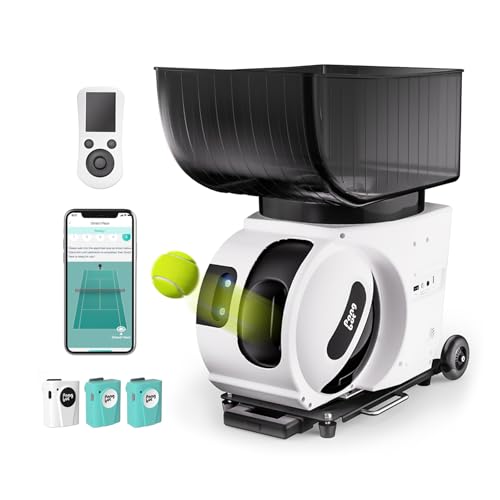
- ✓ Highly customizable drills
- ✓ Powerful and adaptive
- ✓ Portable and easy to use
- ✕ Pricey
- ✕ Slight learning curve
| Ball Speed | Up to 80 mph (128.7 km/h) |
| Spin Rate | Up to 60 RPS (Revolutions Per Second) |
| Oscillation Spots | 6 adjustable positions |
| Battery Life | Over 8 hours of runtime |
| Drill Storage | Supports sync of 30 drills from app to remote |
| Connectivity | App control, remote control, OTA updates |
There’s a common misconception that personal tennis ball machines are just glorified ball dispensers with limited features. After trying out the PONGBOT PACE S PRO, I can confidently say it’s a whole different ball game.
The first thing that struck me is how sleek and portable it feels. Its compact design easily fits in my trunk, and the wheels make it simple to move around the court.
The remote control and app syncing took about a minute to set up, and I was impressed by the variety of pre-loaded drills—over 300—that kept my practice sessions dynamic.
The smart sensors are a game-changer. During rally drills, I noticed how it adapted the ball feeds based on my shot placement, which kept me on my toes.
The ability to customize drills and download new ones from the user community adds a personal touch that makes practice less monotonous.
Power-wise, the machine hits up to 80 mph, simulating real match speeds, and the 60 rpm spin allows for diverse shot types. The oscillation feature with six spots helped me practice both baseline and volley shots without moving too much.
Plus, the long-lasting battery gave me over 8 hours of continuous use, which is perfect for multiple sessions.
Using the remote to open the barrel for ball pickup was smooth, and I appreciated how easy it was to clean and maintain. Whether on clay, hard, or grass courts, this machine performed flawlessly, even on padel courts.
Overall, it’s a powerhouse packed with features that truly elevate your practice. It’s not just for pros—it’s perfect for anyone serious about improving their game at home or on the court.
Furlihong 3807BH Tennis Ball Machine with Triangular Base

- ✓ Stable with triangular base
- ✓ Easy speed adjustments
- ✓ Portable with bag
- ✕ Tennis balls not included
- ✕ Slightly heavy to carry
| Base | Triangular iron base for maximum stability |
| Speed Range | Adjustable from low to high (L to H) |
| Swing Adjustment | Automatic up & down swing with adjustable launch angle |
| Power Options | Battery and AC adapter compatible |
| Portability | Includes carrying bag for easy transport |
| Ball Capacity | Not specified (assumed standard tennis ball size) |
The Furlihong 3807BH Tennis Ball Machine immediately caught my eye with its sturdy triangular iron base, which felt incredibly stable during testing—no wobbling even at higher speeds. It’s a solid choice for anyone looking for reliable, consistent performance without worrying about tipping over. Plus, the included portable carrying bag makes it easy to take from court to court. The Furlihong 3807BH Tennis Ball Machine with Triangular Base is a standout choice in its category.
I really appreciated how easy it was to adjust the speed from low to high, allowing me to tailor my training sessions to my skill level. The automatic up&down swing launch port added a nice touch, letting me control the launch angle with just the press of a button—perfect for simulating real game scenarios. The dual power options, using either batteries or an AC adapter, made it versatile whether I was indoors or outdoors. When comparing different best personal tennis ball machine options, this model stands out for its quality.
Overall, the Furlihong 3807BH Tennis Ball Machine offers a well-rounded experience at $239.99, combining portability, stability, and adjustable features. It’s a fantastic investment for tennis players of all levels wanting to hone their skills with convenient, professional-grade equipment. I’d definitely recommend it for anyone serious about improving their game.
What Features Should You Look for When Choosing a Personal Tennis Ball Machine?
When choosing the best personal tennis ball machine, several key features can enhance your training experience.
- Portability: A lightweight and compact design makes it easier to transport the machine to various locations, whether it’s to the court or for storage at home.
- Ball Capacity: A higher ball capacity means fewer interruptions during practice sessions, allowing you to focus on your game instead of frequently reloading the machine.
- Speed and Spin Settings: Adjustable speed and spin options provide a versatile training experience, enabling you to practice different shots and improve your skills effectively.
- Remote Control: Some machines come with remote control functionality, which allows you to adjust settings without stopping your practice, making training sessions more fluid and efficient.
- Power Source: Consider whether the machine is battery-operated or requires a power outlet. Battery-operated models offer greater flexibility, while plug-in machines may provide consistent performance over long periods.
- Durability and Build Quality: A robust construction ensures the machine can withstand the rigors of outdoor use, including exposure to weather elements, which is essential for longevity.
- Drill Programs: Look for machines that offer pre-programmed drills or customizable settings to simulate match conditions, helping you develop specific skills such as volleys or baseline rallies.
- Warranty and Support: A good warranty and customer support can provide peace of mind, ensuring that you have assistance in case of any issues or defects after your purchase.
How Does Portability Impact Your Selection of a Tennis Ball Machine?
Portability is a crucial factor when selecting the best personal tennis ball machine as it affects ease of transport and storage.
- Weight: The weight of the tennis ball machine significantly influences its portability. Lighter machines are easier to carry and maneuver, making them ideal for players who may need to transport them to different locations such as parks or courts.
- Size: The dimensions of the machine matter for both transport and storage. Compact models can fit into smaller vehicles and take up less space in your home or garage, making them more convenient for personal use.
- Handle and Wheels: Having a machine equipped with a handle and wheels enhances portability. These features allow for easier movement across surfaces, reducing the physical strain of carrying the machine and making it more accessible for quick setup at various locations.
- Power Source: Machines that can operate on batteries offer greater portability since they do not require a nearby power outlet. This feature enables users to practice in remote areas without worrying about power accessibility.
- Assembly Requirements: Some machines require assembly or setup before use, which can hinder portability. A design that allows for quick assembly or is ready to use out of the box will make it easier to bring along for spontaneous practice sessions.
What Ball Feed and Shot Options Should You Consider?
When selecting a personal tennis ball machine, it’s essential to consider various ball feed and shot options that enhance your training experience.
- Fixed Ball Feed: This option allows the machine to deliver balls at a consistent interval, making it ideal for beginners who want to practice timing and stroke repetition. It typically features a preset frequency, which can help players develop rhythm and consistency in their shots.
- Random Ball Feed: A feature that varies the timing and placement of each shot, simulating real-match scenarios. This is beneficial for advanced players who want to work on their reaction time and adaptability, as it closely mimics the unpredictability of an actual opponent.
- Topspin and Backspin Shots: Machines that offer these options enable players to practice against various ball spins, crucial for developing effective returns. Topspin shots help players learn how to handle high-bouncing balls, while backspin shots improve their ability to deal with drops and volleys.
- Adjustable Shot Angles: This feature allows users to set the angle of the ball’s trajectory, which is essential for practicing different types of shots, such as forehands, backhands, and volleys. By adjusting angles, players can simulate various situations they may encounter during a match.
- Speed Settings: Machines with adjustable speed settings allow players to increase or decrease the pace of the feeds according to their skill level and training needs. Slower speeds are beneficial for beginners, while advanced players can challenge themselves with faster feeds to improve their reaction time and shot precision.
- Oscillation: This feature enables the machine to move side to side, delivering balls to different areas of the court. Oscillation is valuable for practicing footwork and positioning, as players must move to hit balls placed throughout the court.
How Can Pricing Influence Your Choice of a Tennis Ball Machine?
Pricing can significantly impact your decision when selecting the best personal tennis ball machine, as it often correlates with features, performance, and durability.
- Budget Models: These machines are typically more affordable and cater to casual players or beginners. They often have limited features, such as fewer speed settings and basic oscillation, making them suitable for those who just want to practice without a hefty investment.
- Mid-Range Models: Priced between budget and high-end machines, mid-range options usually offer a good balance of features and performance. They often include adjustable spin, speed, and oscillation settings, making them versatile enough for intermediate players looking to improve their skills.
- High-End Models: These machines come with advanced features such as programmable drills, remote control, and enhanced durability, catering to serious players and professionals. The higher price point reflects the quality of materials and technology, providing a more realistic practice experience with superior reliability.
- Value for Money: It’s essential to evaluate what features are most important to you and how they align with the price. Often, spending a little more can result in a machine that lasts longer and provides better training options, making it a worthwhile investment in the long run.
- Maintenance Costs: Consider not only the initial purchase price but also the long-term costs associated with maintenance and parts replacement. Some machines may require more upkeep than others, which can add to the overall expense over time.
What Benefits Can You Expect From Using a Personal Tennis Ball Machine?
Using a personal tennis ball machine offers numerous advantages for players looking to improve their skills and practice effectively.
- Consistent Practice: A personal tennis ball machine provides a steady and predictable feed of balls, allowing players to practice their strokes without the variability of a partner’s throws.
- Customizable Drills: Many machines allow users to program specific drills, such as varying ball speeds, spins, and trajectories, tailoring the practice session to individual needs and skill levels.
- Solo Training: With a ball machine, players can train alone at their convenience, enabling them to focus on their game without needing a partner’s availability.
- Improved Footwork: The ability to set the machine to deliver balls at different angles and distances helps players work on their footwork and positioning, essential components of effective tennis play.
- Increased Repetition: Personal tennis ball machines allow for high repetition of specific shots, which is crucial for muscle memory and skill development, especially for beginners and intermediate players.
- Portability: Many models are designed to be lightweight and compact, making them easy to transport to different courts, ensuring that practice can take place anywhere.
- Cost-Effective Training: Over time, investing in a personal tennis ball machine can be more economical than hiring a coach for frequent lessons, providing access to quality practice at a lower ongoing cost.
Each of these benefits contributes to a more effective and personalized training experience, helping players enhance their performance on the court.
How Does a Tennis Ball Machine Help Enhance Your Skills?
A personal tennis ball machine significantly enhances training and skill development for players of all levels. By providing consistent practice, it helps you focus on specific areas of your game without the unpredictability of a hitting partner. Here’s how it contributes to skill enhancement:
-
Repetition: Players can practice serving, returning, and rallying without breaks, allowing for muscle memory to develop effectively. This consistent ball delivery helps in honing timing and footwork.
-
Customizable Drills: Many machines allow users to adjust distance, speed, and spin. Tailoring drills to target weaknesses—such as forehands, backhands, or volleys—enables players to address their unique needs.
-
Realistic Match Simulation: The ability to vary shot types and trajectories replicates the dynamics of an actual match environment, equipping players with the skills to handle different playing styles.
-
Feedback for Improvement: Recording sessions or keeping track of practice milestones using some machines can provide valuable insights into frequency and accuracy, revealing areas that require additional focus.
Utilizing a personal tennis ball machine streamlines practice, helping players refine their skills more effectively than traditional methods.
What Are the Advantages of Solo Practice with a Tennis Ball Machine?
The advantages of using a tennis ball machine for solo practice include enhanced skill development, convenience, and customizable training experiences.
- Skill Development: A tennis ball machine allows players to practice various strokes repeatedly without the need for a partner. This repetition is crucial for honing technique, consistency, and accuracy in hitting the ball.
- Convenience: Having a personal tennis ball machine means you can practice whenever you want without coordinating schedules with others. This flexibility is especially beneficial for those with busy lifestyles or irregular availability for practice partners.
- Customizable Training: Many tennis ball machines come with adjustable settings for speed, spin, and shot frequency, enabling players to tailor their training sessions to focus on specific skills or match situations. This adaptability helps to simulate real-game scenarios and improve overall performance.
- Increased Endurance: Practicing solo with a ball machine allows players to work on their physical conditioning by hitting balls for extended periods. This increased court time can lead to improved stamina and better endurance during matches.
- Targeting Weaknesses: Players can specifically set the machine to deliver balls that challenge their weaknesses, such as backhand returns or volleys. This targeted practice helps to turn vulnerabilities into strengths over time.
How Do Different Personal Tennis Ball Machines Compare and Which Is the Best for You?
| Feature | Machine A | Machine B | Machine C |
|---|---|---|---|
| Price | $300 – Budget-friendly option | $600 – Mid-range with more features | $900 – High-end with advanced technology |
| Ball Capacity | 50 balls – Suitable for casual practice | 100 balls – Ideal for longer sessions | 150 balls – Perfect for intense training |
| Portability | Lightweight – Easy to transport | Moderate weight – Somewhat portable | Heavy – Requires a cart for transport |
| Battery Life | 2 hours – Good for short sessions | 4 hours – Better for extended use | 6 hours – Long-lasting for multiple sessions |
| Speed Settings | Adjustable up to 30 mph | Adjustable up to 40 mph | Adjustable up to 50 mph |
| Spin Options | Topspin only | Topspin and backspin | Topspin, backspin, and sidespin |
| Remote Control | No remote control | Basic remote control | Advanced remote control with programmable settings |
| Warranty Period | 1 year warranty | 2 year warranty | 3 year warranty |
| User Ratings | 4.2/5 based on 100 reviews | 4.5/5 based on 150 reviews | 4.8/5 based on 80 reviews |
What Unique Features Differentiate Top Brands in the Market?
The best personal tennis ball machines on the market are distinguished by several unique features that cater to different player needs and preferences.
- Portability: Many top brands prioritize lightweight and compact designs, making their machines easy to transport and store. This feature is ideal for players who want to take their training sessions to different locations, such as local courts or parks.
- Spin and Trajectory Settings: Advanced machines offer customizable spin and trajectory settings, allowing players to simulate various game scenarios. This helps in developing specific skills, such as handling topspin or slice shots, enhancing overall game performance.
- Remote Control Functionality: Some models come equipped with remote control options, enabling players to adjust settings from a distance. This feature is particularly useful during practice sessions where players can focus on their strokes without the need to constantly walk back to the machine.
- Feed Rate Variability: High-quality machines offer a range of feed rates, allowing users to control the frequency of ball delivery. This adaptability helps players gradually increase their reaction times and improve their game pace at their own comfort level.
- Durability and Build Quality: Top brands often emphasize durability with robust materials that withstand regular use in various weather conditions. This ensures that players invest in a reliable machine that will last for years without frequent repairs or replacements.
- Battery Life: A long-lasting battery is crucial for extended practice sessions. Leading brands offer machines with impressive battery life, allowing users to practice for several hours without needing to recharge, which is especially beneficial for dedicated players.
- Smart Technology Integration: Some modern machines integrate smart technology features, such as mobile app connectivity. This allows players to track their performance, adjust settings, and even access training programs directly from their smartphones, enhancing the training experience.
How Do User Reviews Inform Your Choice of a Personal Tennis Ball Machine?
User reviews play a crucial role in selecting the best personal tennis ball machine by providing insights into real-world experiences and performance.
- Performance Consistency: User reviews often highlight how consistently a machine delivers balls in terms of speed, spin, and trajectory. This information is vital for players who need reliable practice sessions that mimic real match situations.
- Durability and Build Quality: Many reviews discuss the durability of the machine over time, including whether it withstands regular use and outdoor conditions. Understanding a product’s longevity can help buyers avoid machines that may break down after minimal usage.
- Ease of Use: Feedback from users frequently covers the user interface and setup process. Machines that are easy to set up and operate can enhance the overall experience, making practice sessions more enjoyable and productive.
- Portability: Reviews often indicate how easy it is to transport the machine, which is important for players who may want to take their equipment to different locations. A lightweight and compact design can significantly influence a buyer’s decision.
- Value for Money: Users typically share their opinions on whether they feel the machine is worth the price paid. This perspective helps potential buyers gauge if the features and performance justify the cost, especially when comparing multiple options.
What Maintenance Should You Perform on Your Tennis Ball Machine?
Lubricating moving parts, such as gears and hinges, is essential for maintaining the machine’s functionality. Proper lubrication minimizes wear and tear, ensuring a longer lifespan and smoother operation of the machine.
Finally, testing the settings involves going through various speed and spin options to ensure they function as intended. Familiarity with the settings allows you to make quick adjustments during practice, tailoring the workout to your specific needs.
How Can You Maximize the Lifespan of Your Tennis Ball Machine?
Maximizing the lifespan of your tennis ball machine involves regular maintenance and thoughtful usage practices.
- Regular Cleaning: Keeping the machine clean is crucial for its longevity. Dust and debris can clog moving parts and affect performance, so routinely wipe down the exterior and remove any balls or dirt from the internal components.
- Proper Storage: Store your tennis ball machine in a dry, temperature-controlled environment. Extreme temperatures and humidity can damage internal electronics and mechanisms, so find a safe space when not in use.
- Battery Maintenance: If your machine is battery-operated, ensure that the battery is charged properly and replaced when necessary. Overcharging or allowing the battery to fully deplete can shorten its lifespan, so follow the manufacturer’s guidelines for optimal usage.
- Ball Quality: Use high-quality tennis balls that are appropriate for your machine. Poor-quality or damaged balls can cause jamming or wear on the machine’s feeding mechanism, leading to more frequent repairs.
- Routine Inspections: Periodically check the machine for any signs of wear or damage. Look for loose screws, frayed wires, or damaged parts, and address any issues promptly to prevent further damage.
- Follow Manufacturer Guidelines: Adhering to the user manual and maintenance recommendations provided by the manufacturer is essential. This includes understanding the proper settings for different drills, as using incorrect settings can strain the machine unnecessarily.
- Avoid Overuse: While it can be tempting to use the machine extensively, giving it rest between sessions can prevent overheating and prolong its life. Plan your training sessions to allow the machine to cool down as needed.